
Navigation · Level R3 · 4 parts · about 12 min
Tidal streams: atlases, tidal diamonds and timing a passage
4 short parts: Diamonds, atlases · Springs and neaps · Headlands · Wind against tide. Each part explains the idea, then gives the points to remember, the common mistakes, a worked case and a practice question; the Academy unit adds all 24 check questions.
1 · Diamonds, atlases
Tidal diamonds and tidal stream atlases
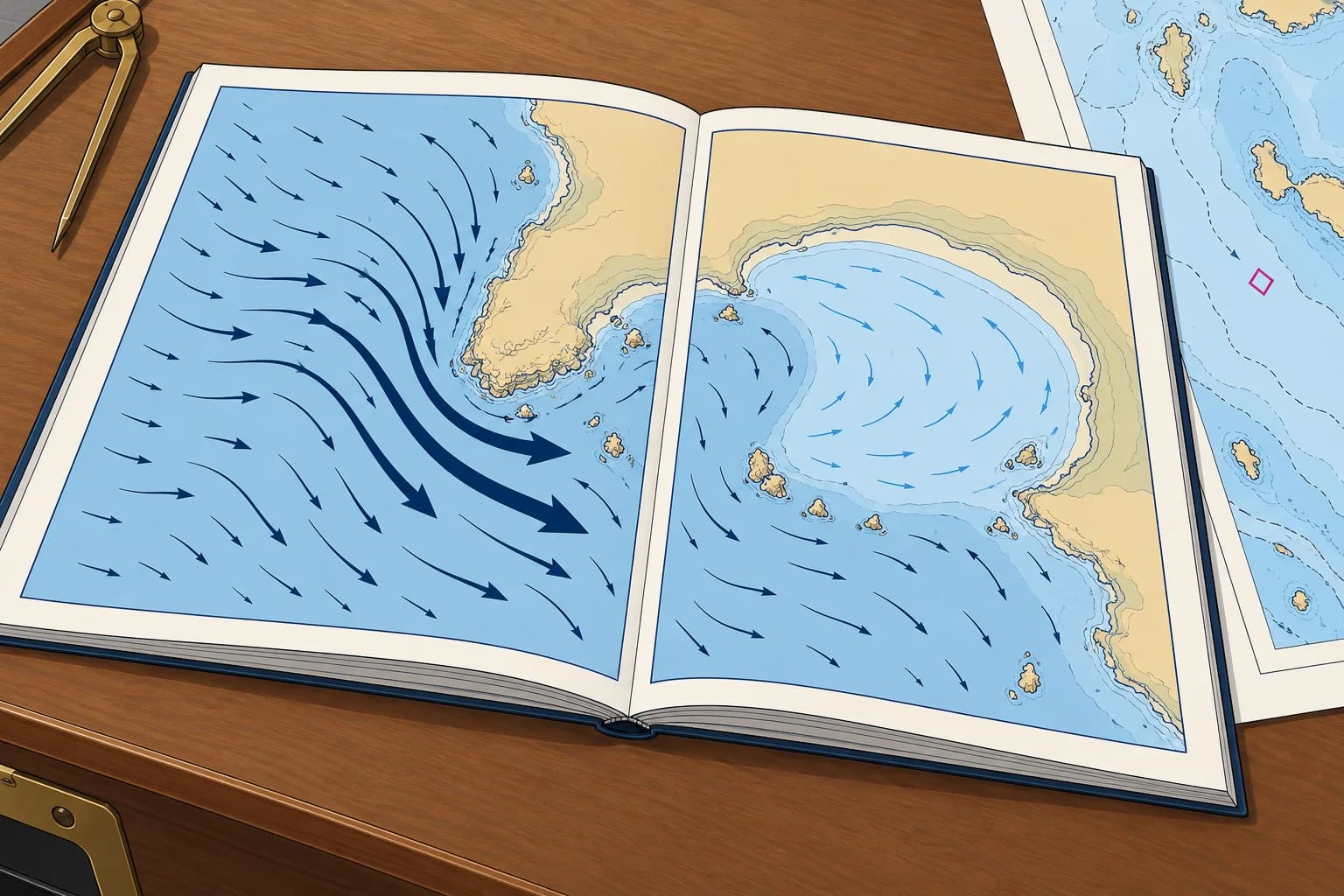
Charts and atlases give the stream hour by hour, counted from high water at a standard port. Learn to read both and to pick the right hour.
Tidal streams
A tidal stream is the tide’s horizontal flow; tidal heights are covered in the Tides unit. Flood and ebb name the two main stream phases, usually incoming and outgoing in an estuary. Slack water, where it occurs, means little or no stream, usually near reversal. Stream phases need not match the local rise and fall. Find slack timing from local stream predictions, not simply high water (HW) or low water (LW).
Tidal diamonds
On many charts, a tidal diamond is a letter in a magenta diamond. Its table gives the set (direction the water flows towards, in degrees true) and rates (speeds in knots) at mean springs (larger-range tides) and mean neaps (smaller-range tides). Rows run from six hours before to six hours after HW at a named standard port, the reference port for the table.
Picking the hour
Check the tide table’s time basis. Convert HW and your passage time to the same zone, using the full UTC (Coordinated Universal Time) offset, including daylight saving. Look up HW at the standard port named in the stream table. Each row covers half an hour either side of its time. With HW at 1340, the HW+3 row applies from 1610 to 1710.
Tidal stream atlases
A tidal stream atlas has one page per hour, from HW−6 to HW+6 at its standard port. Arrows show the direction: thick, dark arrows for strong streams, thin ones for weak. Figures give rates in tenths of a knot, neaps first: 08,15 means 0.8 kn at neaps and 1.5 kn at springs. The comma marks the spot the figures refer to.
Other sources
Almanacs reproduce atlas pages, pilot books describe local streams in words, and plotters and apps show modelled streams. Use the source with the best detail for your area and cross-check unusual figures. In much of the Mediterranean tidal streams are weak, but currents still matter: the Strait of Gibraltar has a near-permanent east-going surface current with tidal streams on top.
Key figures
- Diamond table
- Set °T; spring and neap rates (kn); HW−6 to HW+6
- Times refer to
- HW at the standard port named in the table or atlas
- Each hourly row
- From 30 min before to 30 min after its time
- Atlas figures 08,15
- Neaps 0.8 kn, springs 1.5 kn (tenths of a knot)
- Set and rate
- Set: direction towards, °T. Rate: speed, kn.
Remember
- Diamond tables give set (°T) and spring and neap rates for each hour from HW−6 to HW+6.
- Times count from HW at the named standard port, in the right time zone.
- Each hourly row covers half an hour either side of its time.
- Atlas figures are tenths of a knot, neaps first: 08,15 = 0.8 and 1.5 kn.
Common mistakes
Wrong: The HW+3 row runs from HW+3 to HW+4.
Right: It is centred on HW+3: it runs from HW+2½ to HW+3½.
Wrong: In the atlas, the first figure is the spring rate.
Right: Neaps come first: in 12,25 the neap rate is 1.2 kn and the spring rate 2.5 kn.
Wrong: Slack water is always at high and low water.
Right: Slack means little or no stream. Its timing varies locally and need not coincide with HW or LW. Check local stream predictions.
Worked case
HW at the named standard port is 0915 UTC. Your watch is UTC+2. You pass diamond F at 1410 watch time. A crew member selects HW+5. Which row do you use?
Show the answer
1410 watch time is 1210 UTC, 2 h 55 min after HW. Use HW+3, covering 1145–1245 UTC. HW+5 mixes time zones. Read the set and rates from HW+3.
Practice question
What does 12,25 mean on a tidal stream atlas page?
- Springs 1.2 kn, neaps 2.5 kn
- Neaps 1.2 kn, springs 2.5 kn
- Set 012°T, rate only 2.5 kn
- Neaps 12 kn, springs 25 kn
Show the answer
Answer: B. Rates are in tenths of a knot, neap rate first, then spring rate.
2 · Springs and neaps
Springs, neaps and interpolation
Tables give rates for mean springs and mean neaps. On any other day, work out the rate from that day's tidal range.
Range drives rate
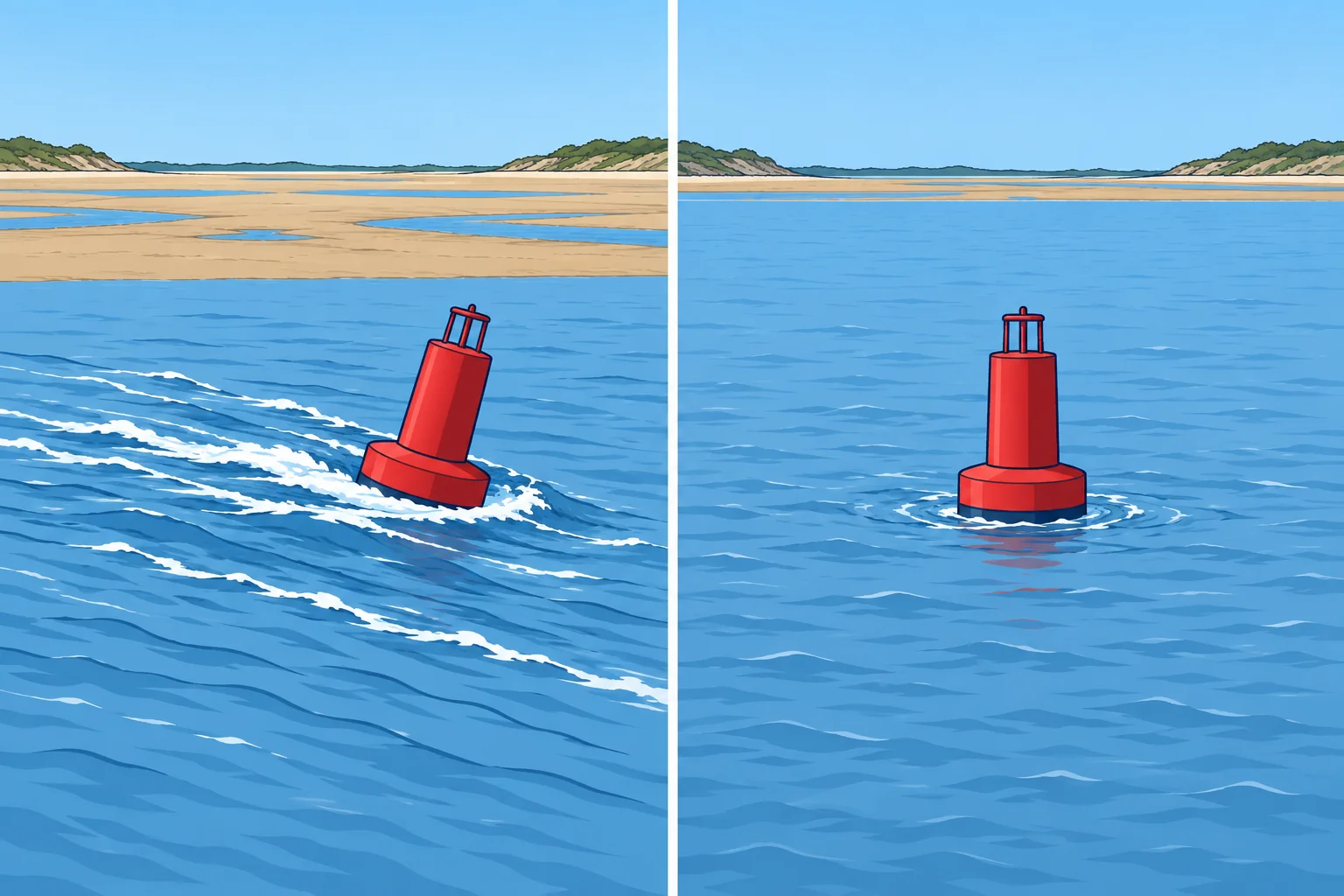
The range of the tide is the height difference between a high water and the next or previous low water. A bigger range moves more water, so streams run faster. Atlases and diamond tables give rates for their standard port’s mean spring range and mean neap range; mean means average. The atlas or tide tables give those two ranges.
Interpolating
Find the day’s range at the standard port. Work out where it lies between the mean neap and mean spring ranges, as a fraction. Apply the same fraction between the neap and spring rates. On the computation of rates diagram, mark the neap and spring rates on their labelled scales. Join the marks and read the rate at today’s range.
Worked example
Mean ranges: springs 4.6 m, neaps 1.8 m. Today HW is 5.0 m and LW 1.3 m: range 3.7 m. The diamond gives springs 2.4 kn, neaps 1.2 kn. Fraction = (3.7 − 1.8) ÷ (4.6 − 1.8) = 1.9 ÷ 2.8 = 0.68. Rate = 1.2 + 0.68 × (2.4 − 1.2) = 1.2 + 0.8 = 2.0 kn.
Outside the mean ranges
On a big spring tide the day's range can exceed the mean spring range, and the stream runs faster than the spring figure. Extending the same straight line gives an estimate; treat it as approximate and keep a margin. Below mean neaps the stream is weaker than the neap figure.
Quick check
A rough rule says neap rates are about half the spring rates. Use it to spot a misread table, not instead of the table. Round to 0.1 kn: the tabulated figures are averages, and wind and air pressure change real streams.
Key figures
- Range
- HW height − LW height at the standard port
- Fraction
- (Day's range − neap range) ÷ (spring range − neap range)
- Rate
- Neap rate + fraction × (spring rate − neap rate)
- Worked example
- Range 3.7 m between 1.8 and 4.6 m → 2.0 kn
- Above mean springs
- Faster than the spring figure; extrapolate with a margin
Remember
- Rate depends on the day's range at the standard port, not on the date alone.
- Interpolate: the range's place between neaps and springs gives the rate's place.
- Use the computation of rates diagram, or the formula, and round to 0.1 kn.
- Above mean springs the stream is stronger than the spring figure.
Common mistakes
Wrong: It is full moon, so use the spring rate.
Right: Springs come a day or two after new and full moon, and they vary in size. Work from the day's range.
Wrong: Use the range at your own harbour.
Right: Use the range at the standard port named on the table or atlas; that is what the rates refer to.
Wrong: The spring rate is the most a stream can run.
Right: On ranges bigger than the mean spring range the stream runs faster still.
Worked case
Mean ranges are springs 5.0 m and neaps 2.0 m. Today’s range is 5.6 m. Your hourly rates are springs 3.0 kn and neaps 1.4 kn. A crew member says to cap the estimate at 3.0 kn. Do you agree?
Show the answer
No. The range exceeds mean springs. Fraction = (5.6 − 2.0) ÷ (5.0 − 2.0) = 1.2. Estimated rate = 1.4 + 1.2 × (3.0 − 1.4) = 3.32 kn, about 3.3 kn. Treat extrapolation as approximate and retain a margin; 3.0 kn is not a maximum.
Practice question
Mean ranges: springs 4.0 m, neaps 2.0 m. Today's range is 3.0 m. Rates: springs 2.0 kn, neaps 1.0 kn. What is today's rate?
- 2.0 kn
- 1.0 kn
- 1.5 kn
- 3.0 kn
Show the answer
Answer: C. 3.0 m is halfway between 2.0 and 4.0 m, so the rate is halfway between 1.0 and 2.0 kn: 1.5 kn.
3 · Headlands
Headlands, races and timing a passage
Streams run hardest off headlands and through narrows. Time your passage so the stream carries you round, close to slack if the sea there can be rough.
Why headlands
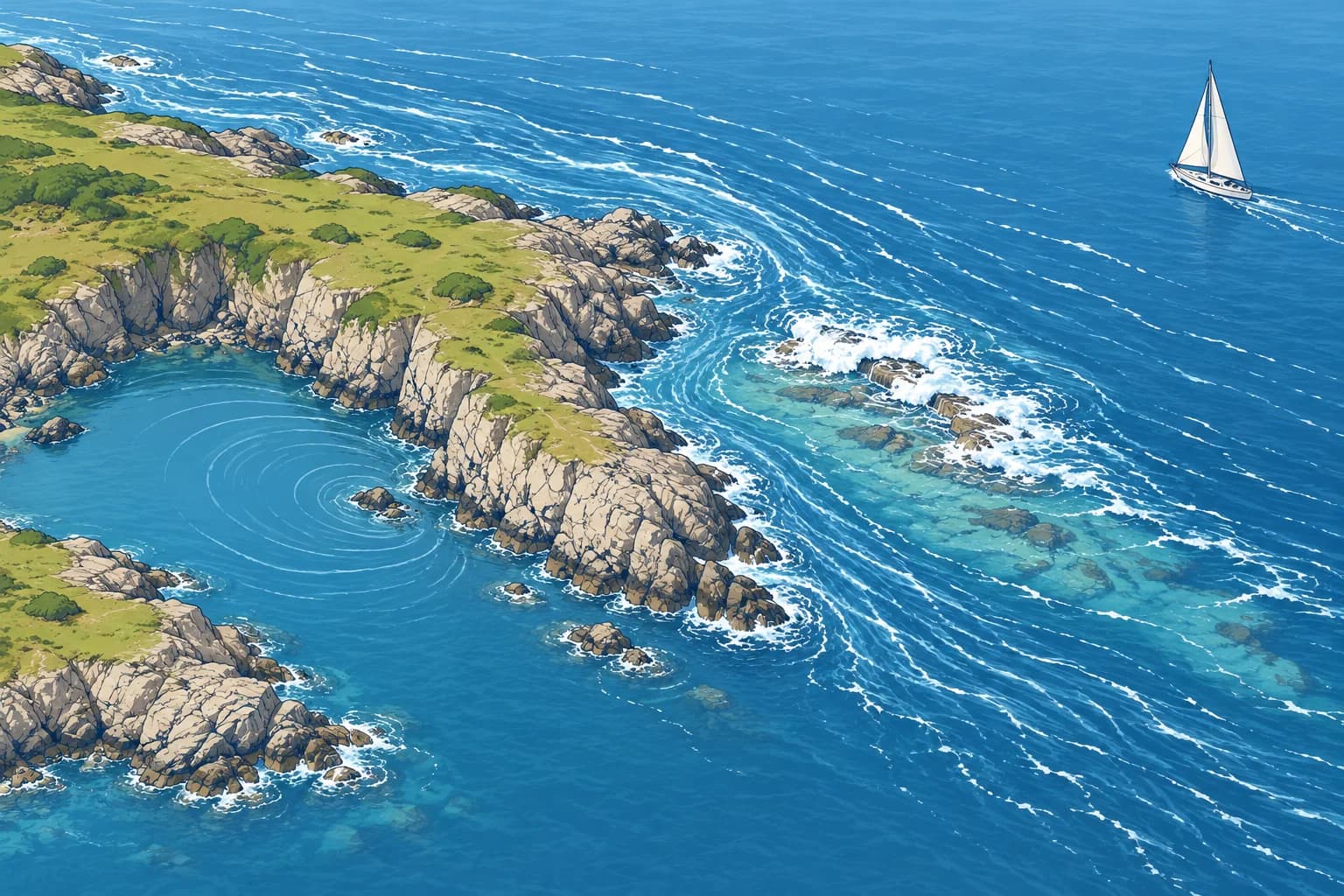
Water flowing along a coast speeds up as it squeezes round a headland or through a narrow channel. Rates off a headland can be much higher than a few miles away, and the stream often turns earlier close inshore than offshore. In bays and behind headlands you can find eddies, where the water runs the opposite way to the main stream.
Races and overfalls
Where a fast stream runs over an uneven seabed or an underwater ledge, the surface breaks into overfalls: steep, confused, breaking seas, even in light wind. A tidal race is a fast, concentrated tidal stream, often off a headland or in narrows; it may produce overfalls. Charts mark overfalls with a wavy-line symbol, and pilot books say how far they reach and when they are worst.
Timing
Work backwards from the headland. Find in the atlas when the stream there turns fair (running with you), then the time you need to get there at your expected speed over ground (SOG). Aim to arrive near slack or early in the fair stream, so it carries you round and on. Arriving after it has turned foul (against you) can stop a small boat almost dead.
Inshore or offshore
Pilot books often describe a passage close inshore that avoids a race in settled weather, or advise standing well out to sea. Follow that local advice, keep the engine ready and leave space to manoeuvre safely (sea room). Swell is waves travelling beyond the wind that formed them. Never cut through a race to save time, and never choose the inshore passage in an onshore swell.
Key figures
- Fair stream
- Running with your course
- Foul stream
- Running against your course
- Overfalls
- Breaking seas where a fast stream crosses a ledge or bank
- Tidal race
- Fast, concentrated tidal stream; may produce overfalls
- Plan backwards
- From the time the stream turns fair at the headland
Remember
- Streams are strongest off headlands and in narrows; they may turn earlier inshore.
- A tidal race is a fast, concentrated stream; its overfalls can break even in light wind.
- Plan backwards from when the stream turns fair at the headland.
- Follow the pilot book's inshore or offshore advice; never cut through a race.
Common mistakes
Wrong: Leave when you are ready and see what the stream does.
Right: Plan the departure time from the time the stream turns fair at the headland.
Wrong: The stream at the headland turns at HW at the standard port.
Right: Read the headland's own hours from the atlas or pilot book; they can differ by several hours.
Wrong: A race is safe in light wind.
Right: Overfalls can break in a calm. Swell, waves travelling beyond the wind that formed them, becomes steeper against the stream.
Worked case
The headland is 15 M away. Its stream turns fair at 1100. You planned 5 kn average SOG and an 0800 departure. The pilot advises passing near slack to avoid the race. You now expect 4 kn. Does the plan still work?
Show the answer
At 4 kn, allow 3 h 45 min: departure becomes about 0715. Leaving at 0800 gives an arrival around 1145, later than your near-slack target. A fair stream alone does not justify that arrival. Recheck the pilot’s timing and route advice before deciding whether to proceed.
Practice question
Where do tidal streams usually run fastest?
- In the middle of wide bays
- Off headlands and in narrows
- Close inshore, deep in bays
- Over deep, even open water
Show the answer
Answer: B. Water accelerates as it squeezes round headlands and through narrow channels.
4 · Wind against tide
Wind against tide
When the wind blows against the stream, waves become shorter, steeper and break. Plan the hours when wind and stream run the same way.
What happens
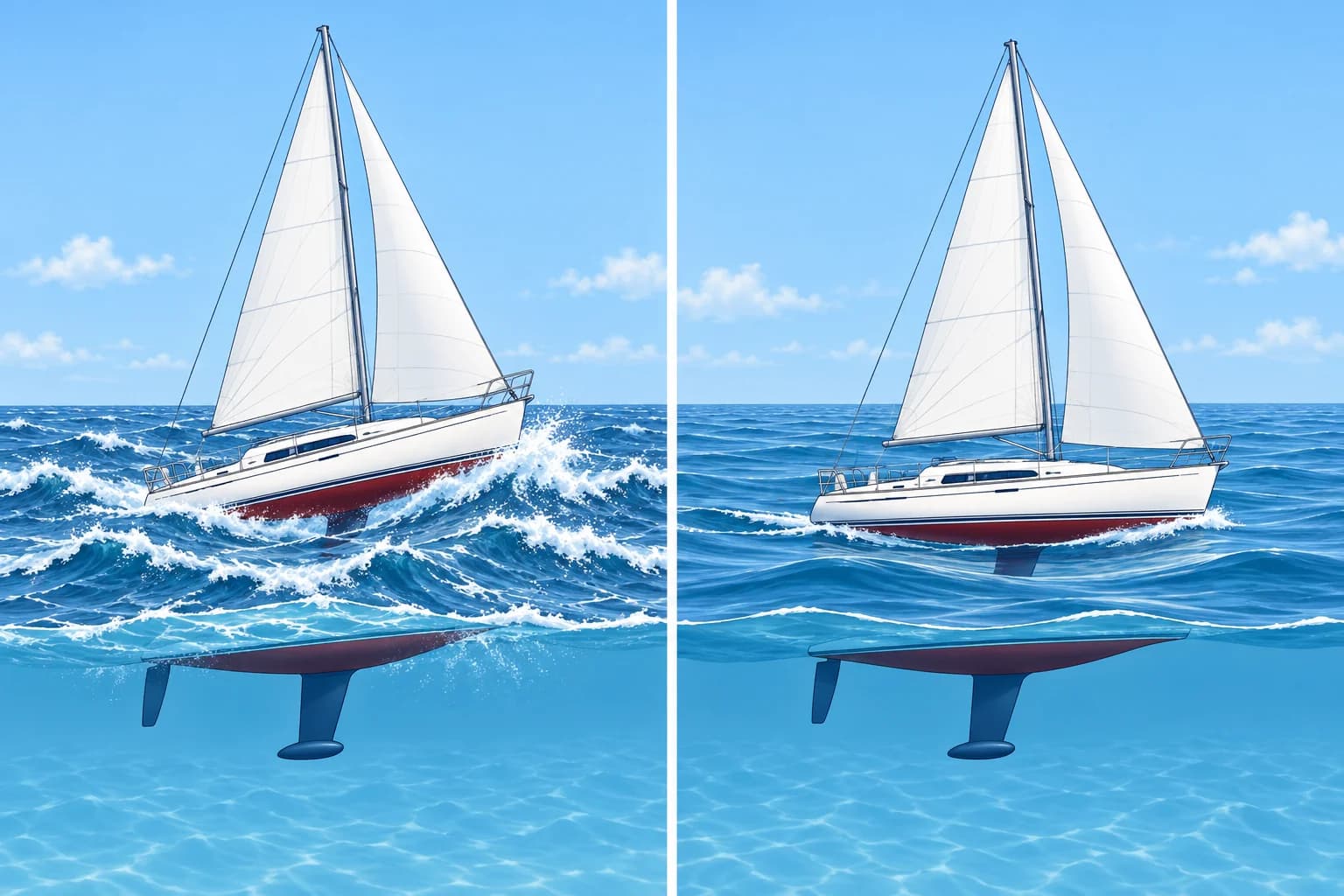
Waves travel with the wind. When the stream runs against them, called wind against tide (or wind over tide), the waves shorten and steepen and more of them break. In a strong stream a moderate breeze can raise a sea that is dangerous for a small boat. When wind and stream run the same way, the waves are longer and lower.
Name them the right way
Wind is named for where it comes from; stream set for where it goes towards. A westerly wind blows towards the east, so a stream setting 090°T runs with it, while a stream setting 270°T runs against it.
Where it is worst
The effect grows with the rate of the stream. It is strongest when the local opposing stream runs fastest; check local rates. Springs, headlands, narrows and shoals (shallow patches) can worsen it. An estuary bar is a shallow ridge across its entrance. An opposing stream also steepens swell coming in from offshore, even with little wind. Avoid crossing a bar on the ebb when the wind or swell is onshore.
Planning
For each hour of the passage, set the forecast wind against the atlas. Mark the hours when they oppose at the danger spots. Shift your departure, pick a route away from races and bars, or wait for neaps or less wind. A fair stream against the wind gives speed but a rough sea; a foul stream with the wind gives a smoother sea but slow progress. Write the choice and the reason in your plan.
Key figures
- Wind against tide
- Shorter, steeper, breaking seas
- Worst
- Peak opposing stream; springs, headlands, narrows, shoals and bars
- Wind direction
- Where it blows FROM
- Stream set
- Where it flows TOWARDS
- Bar crossing
- Avoid the ebb with onshore wind or swell
Remember
- Wind against tide makes short, steep, breaking seas; with the wind the sea is easier.
- Wind is named from, stream set towards: a westerly and a 090°T stream run together.
- Worst near the peak opposing stream, especially at springs, off headlands, in narrows and over bars.
- Plan departure times and routes so wind and stream do not oppose at danger spots.
Common mistakes
Wrong: A westerly wind and a stream setting 090°T are opposed.
Right: Both run towards the east. A westerly opposes a stream setting 270°T.
Wrong: Wind against tide only matters in a gale.
Right: In a strong stream, a moderate breeze or an offshore swell can be enough to make dangerous seas.
Wrong: With a good engine you can cross a bar at any state of tide.
Right: Follow local bar guidance. You need adequate depth, a suitable stream and no breaking seas; HW does not guarantee slack.
Worked case
Forecast: west, force 5. You are heading east round a headland with a race. There the stream sets 270°T from HW−6 to HW, and 090°T from HW to HW+6 at the standard port. When is the race worst, and when do you round it?
Show the answer
The westerly opposes the 270°T stream from HW−6 to HW. Check the atlas rates to find the strongest hours. After HW, the 090°T stream runs with the wind and your course. Subject to local advice and suitable sea conditions, aim for early in that stream and keep clear of the race.
Practice question
The wind is from the north. Which stream gives wind against tide?
- A stream setting 180°T
- A stream setting 090°T
- A stream setting 270°T
- A stream setting 000°T
Show the answer
Answer: D. A north wind blows towards the south. A stream setting 000°T runs north, against it.