
Navigation · Level R4 · 5 parts · about 16 min
Offshore passages: night sailing, watches and landfall
5 short parts: Night sailing · Watch systems · Fatigue · Landfall · OSR & checklist. Each part explains the idea, then gives the points to remember, the common mistakes, a worked case and a practice question; the Academy unit adds all 28 check questions.
1 · Night sailing
Night sailing: seeing, being seen and staying aboard
At night you see less, judge distance badly and are harder to recover if you fall in. Protect your night vision and tighten the deck rules.
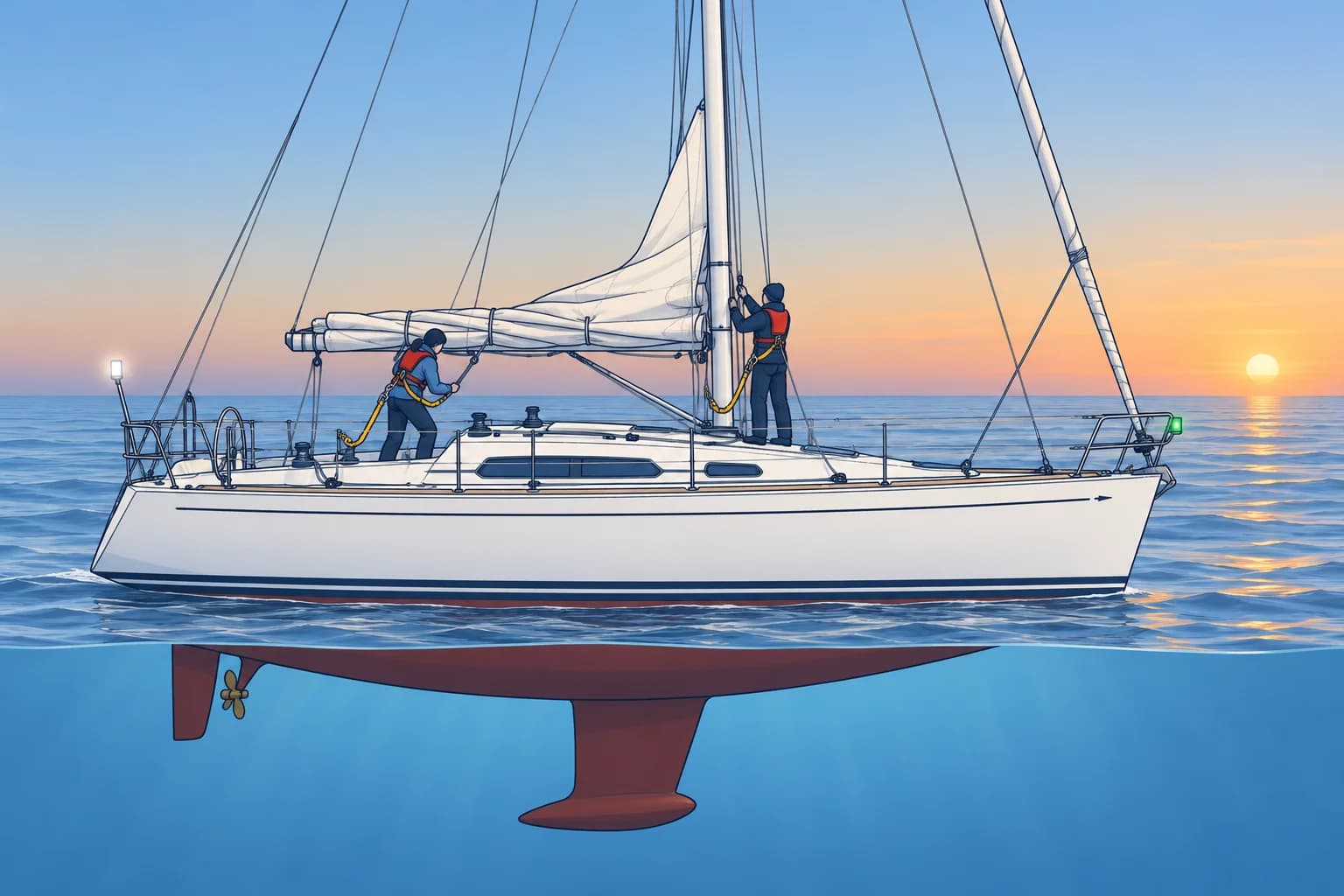
Prepare before dark
Do the jobs that are hard at night while it is still light: put in the reef you may need, rig the jackstays, check the navigation lights, set out torches and the night-vision red light, and prepare food and hot drinks. Brief the crew on the night's plan, the lights to expect and when to call the skipper. A passage plan already lists the lights you expect to see; the Passage planning unit shows how.
Night vision
Your eyes take about 20 to 30 minutes in the dark to reach full night vision. One look at a bright screen or a white torch spoils it for many minutes. Use dim red light below and in the cockpit, turn plotter and instrument screens to night mode, and look away from bright lights. Scan the horizon slowly: at night you see a faint light better slightly off-centre.
Lights
Show the correct navigation lights from sunset to sunrise and in restricted visibility, and check them at dusk. Recognise ships' lights to judge what they are and which way they are heading; the COLREG lights units are the home for that. At night distance is hard to judge, so take a compass bearing of each light that may be closing and watch it.
Deck rules
Wear a lifejacket with a light, and clip on before you leave the companionway, and stay clipped on until you are below again. Nobody goes forward without telling the helm, and never alone in rough weather if you can avoid it. A crew member who falls in at night is very hard to see and to recover. The Safety equipment unit covers harnesses, tethers and jackstays.
Calling the skipper
The skipper's standing orders say when the watch must call them, for example: any ship closing with a steady bearing, a wind change or rise, a light not identified, a deviation from the plan, or simply doubt. Calling early is good seamanship, not a failure.
Key figures
- Full night vision
- About 20–30 minutes in the dark; lost quickly to white light
- Navigation lights
- Sunset to sunrise and in restricted visibility (COLREG Rule 20)
- On deck at night
- Lifejacket with light; clipped on from companionway to companionway
- Spanish terms
- Navegación nocturna, luces de navegación, órdenes permanentes
Remember
- Reef, rig jackstays and prepare torches and food before dark.
- Protect night vision: red light, night-mode screens, no white torches in the cockpit.
- Clip on before leaving the companionway; never go forward without telling the helm.
- Standing orders tell the watch when to call the skipper; call early when in doubt.
Common mistakes
Wrong: Delay an already-needed reef until after dark.
Right: Reef in daylight for expected conditions. If the wind later rises beyond them, reef promptly and safely using the agreed deck precautions.
Wrong: Check the plotter at full brightness to see it better.
Right: Bright screens ruin night vision. Use night mode and dim red light.
Wrong: Clip on once you reach the side deck.
Right: Clip on before you leave the companionway, to a strong point you can reach from below.
Worked case
At 2300 the wind rises to force 5 and the new watch wants to reef. One crew member goes forward without a harness while the other steers with the cockpit lit by a white head torch. You are woken by the noise. What do you change?
Show the answer
Stop the work until both are clipped on, with lifejackets and lights, and the helm knows who is on deck. Switch the head torch to red or off to protect night vision. Next time, reef before dark for the expected wind. Write in the standing orders that the watch calls you before any deck work at night, and brief it at the evening meal.
Practice question
About how long do your eyes need in the dark to reach full night vision?
- About 2 to 3 minutes
- About 5 seconds only
- About 2 to 3 hours
- About 20 to 30 minutes
Show the answer
Answer: D. Dark adaptation takes about 20 to 30 minutes. A bright white light undoes much of it at once.
2 · Watch systems
Watch systems: sharing the night
A watch system decides who is on deck, who rests and when. Pick one that fits your crew, keep it from the start and rest the skipper too.
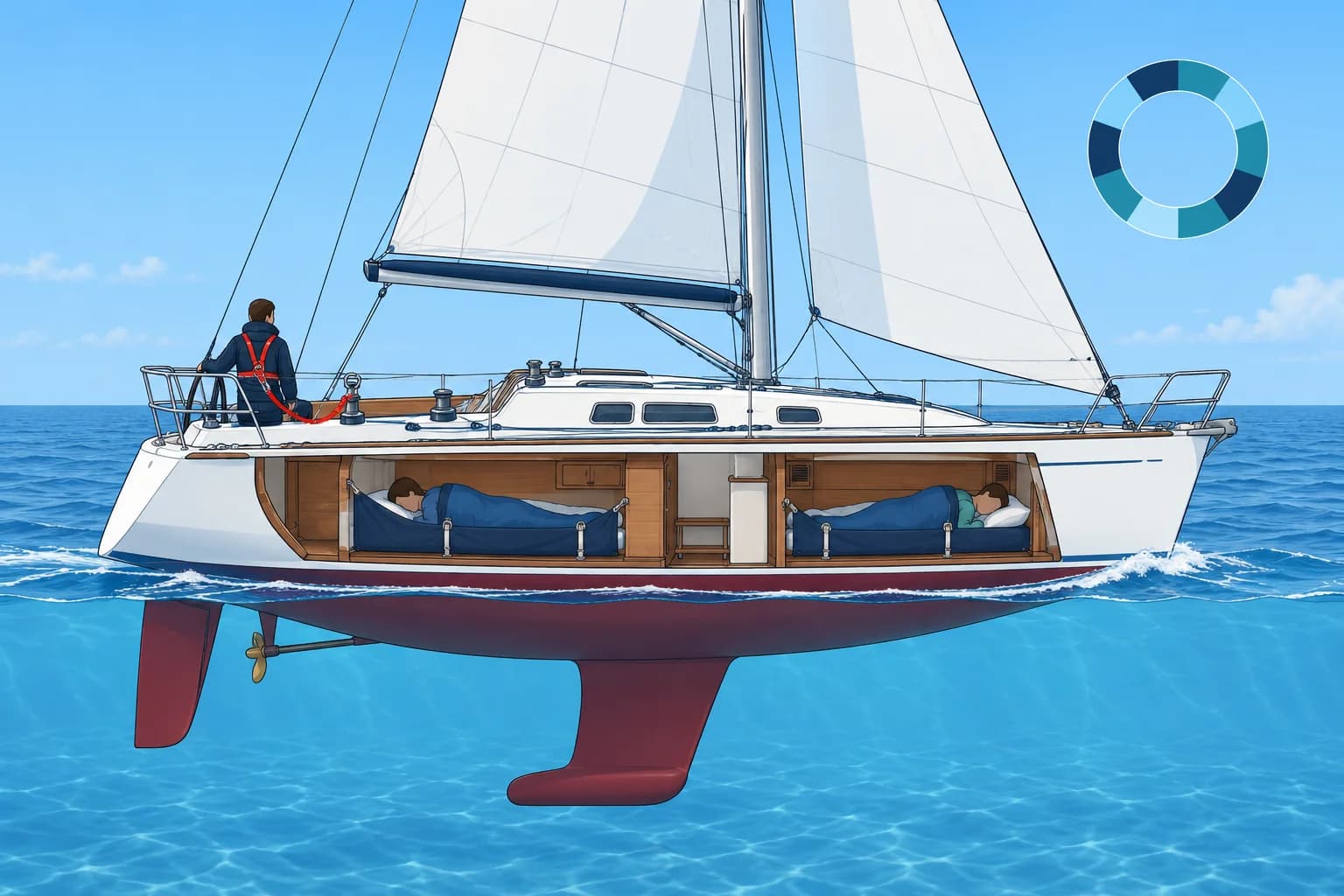
Why a system
On a passage of more than a day, everyone needs regular sleep, and someone must always keep lookout (COLREG Rule 5). A watch system sets fixed times on and off. Start it as soon as you leave, not when people get tired. Write it up where everyone can see it.
Two watches
4 on, 4 off alternates two watches. With four crew, each watch can have two people. Four hours off gives less than four hours asleep once handover, meals and preparation are allowed for. 3 on, 3 off shortens each duty period, which can help in cold or rough weather, but also shortens each rest opportunity.
Single watchkeepers
With three crew, 3 on, 6 off puts one person on deck at a time and gives each six hours off. Use a lone watch only when competence, conditions and workload allow a proper lookout; call support early. The others must be ready to wake and help. Swedish-type systems use longer day watches and shorter night watches; versions vary. With two alternating teams, an odd number of daily duty periods swaps their clock times. For three watchkeepers, check the full rota; an odd number alone does not guarantee rotation.
The skipper
The skipper is needed most when tired is most dangerous: at landfall, in bad weather or in an emergency. Many skippers keep out of the watch system, or take a light share, and sleep when they can. On a short-handed boat, plan for the skipper to sleep too.
Handover
At each change, the outgoing watch tells the next one: course and speed, sails, the position on the chart, ships and lights in sight, weather trend and anything odd. The new watch must be alert, with eyes adjusted and a harness on before taking over. Record the handover in the log.
Key figures
- 4 on, 4 off
- Two alternating watches; sleep time is less than off-watch time
- 3 on, 6 off
- Three single watchkeepers; six hours off each
- Swedish-type
- Longer day watches, shorter night watches; no single standard
- Lookout
- COLREG Rule 5: proper lookout at all times
- Spanish terms
- Guardia, cuarto, relevo de guardia, cuaderno de bitácora
Remember
- Start the watch system as soon as you leave, before anyone is tired.
- 4 on, 4 off for two watches; 3 on, 6 off only if each person can safely keep watch alone.
- With two alternating teams, odd daily duty periods swap clock times; Swedish-type versions vary.
- Keep the skipper rested for landfall and emergencies; hand over properly.
Common mistakes
Wrong: Start watches at dark when people get tired.
Right: Start the system from departure, so that people rest before the first night.
Wrong: The skipper keeps a full watch and also every hard job.
Right: A worn-out skipper is a risk. Leave the skipper some protected rest.
Worked case
Three of you are sailing 220 NM, about 40 hours. The other two want to keep everyone on deck together through the first night 'for safety', then rest on day two. Your landfall is planned at 0500 on the second night. What do you propose?
Show the answer
Everyone on deck all night means everyone tired for landfall. Use 3 on, 6 off only if each person can safely keep the watch alone; otherwise arrange overlapping support and revise the rota. Start from departure. Keep the others ready to wake and help. Protect your rest as skipper before 0500. Agree when to call you and review the rota after the first night.
Practice question
Three crew can each safely keep watch alone. Which system gives each six hours off?
- 4 on, 4 off
- 3 on, 6 off
- 6 on, 6 off
- 2 on, 2 off
Show the answer
Answer: B. Three single watchkeepers each doing three hours gives every person six hours off. Use this only when competence, conditions and workload allow a proper lookout; call support early.
3 · Fatigue
Fatigue: sleep debt, the body clock and naps
Fatigue builds up over days and peaks before dawn. Plan sleep like fuel, recognise the signs and use naps wisely.
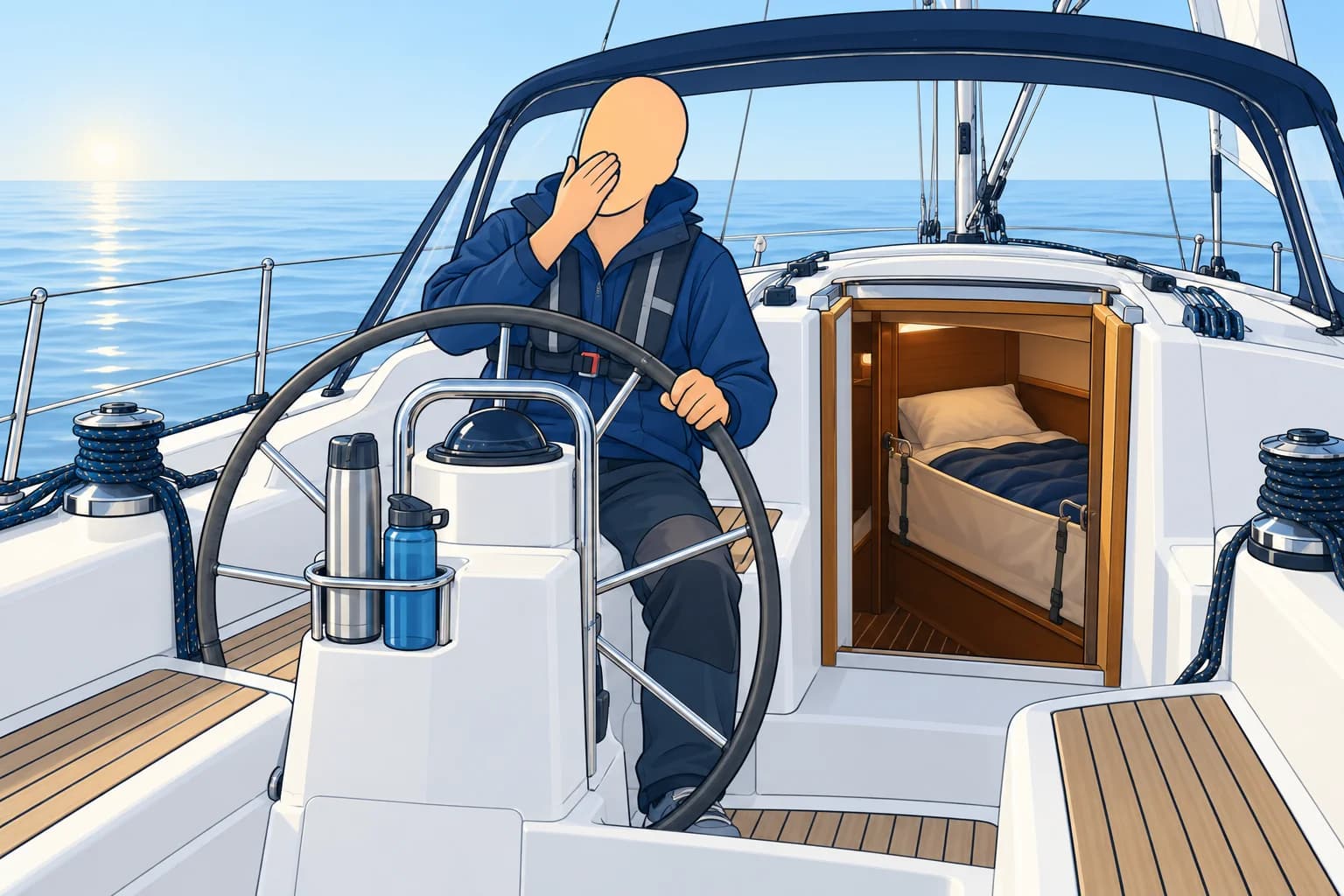
Sleep debt
Most adults need about seven to nine hours' sleep in 24. On passage you get it in pieces, and broken sleep is less restful. Each short night adds to your sleep debt. After about 17–19 hours awake, reaction and judgement can be as poor as after drinking alcohol. Fatigue appears in accident reports again and again: a watchkeeper falls asleep and the boat sails on.
The body clock
Your circadian rhythm, the body clock, makes you sleepiest between about 0200 and 0600, with a smaller dip in the early afternoon. Night watches in that window are the hardest and the most error-prone. Put your most alert people there when you can, and keep that watch short.
Naps
A short nap of about 20–30 minutes can help, but deep sleep may begin sooner when you are sleep-deprived. About 90 minutes may allow a full sleep cycle; timing varies. Sleep inertia means grogginess after waking. It often lasts 15–30 minutes, sometimes longer. Allow at least 15–30 minutes before watch, longer if needed, and do not take over until alert. Wake early enough to dress and adapt your eyes.
What makes it worse
Cold, wet conditions, seasickness, dehydration, hunger and noise make fatigue worse. Keep bunks warm and dry. A lee cloth is a fabric barrier that keeps you in your bunk. Eat regularly and drink water. Avoid alcohol. For seasickness treatment, see Medicine chest.
Signs to watch
Yawning, slow reactions, missing steps in a routine, poor decisions, irritability and microsleeps, brief lapses you may not notice. If you see them in yourself or others, say so and change the plan: shorten watches, heave to or reduce sail, and put an alert person on deck.
Key figures
- Daily sleep need
- About 7–9 hours in 24 for most adults
- Circadian low
- About 0200–0600, with a smaller early-afternoon dip
- Short nap
- 20–30 min target; 90 min may allow a cycle; timing varies
- Sleep inertia
- Often 15–30 min after waking; sometimes longer
- Spanish terms
- Fatiga, deuda de sueño, ritmo circadiano, siesta corta
Remember
- Sleep debt adds up over the passage; broken sleep is less restful.
- The body clock's low, about 0200–0600, is the riskiest time for watchkeepers.
- Short naps can refresh; allow grogginess to clear before taking over.
- Cold, seasickness, hunger and dehydration all make fatigue worse.
Common mistakes
Wrong: Coffee cures fatigue.
Right: Caffeine can mask it for a while. Only sleep repays sleep debt.
Wrong: Wake the next watch at the minute their watch starts.
Right: Wake early enough to dress and adapt your eyes. Allow at least 15–30 minutes for grogginess, longer if needed; take over only when alert.
Wrong: Tiredness is a matter of willpower.
Right: Fatigue impairs judgement however motivated you are. Plan sleep like fuel.
Worked case
On day three of a passage, the 0300 watchkeeper misses a ship's lights until it is 1 NM away, then argues about a simple course change. The crew have slept in two-hour pieces since leaving. What is happening, and what do you change?
Show the answer
These are signs of fatigue: a growing sleep debt plus the circadian low around 0300. Take over or put an alert person on deck now. Then change the system so each person gets longer unbroken sleep, keep the hardest night watch short, and give each sleeper a warm, dry bunk, hot food and water. Consider slowing or heaving to for a rest if the crew cannot recover.
Practice question
At about what time of night is a watchkeeper most likely to be sleepy and make mistakes?
- Between 2000 and 2200
- Between 2200 and 0000
- Between 0200 and 0600
- Between 0800 and 1000
Show the answer
Answer: C. The body clock's low point is around 0200 to 0600, so those watches carry the most fatigue risk.
4 · Landfall
Making a landfall: aiming off, lights and timing
After a long passage, assess how certain your position is. Plan an approach that tolerates the remaining error.
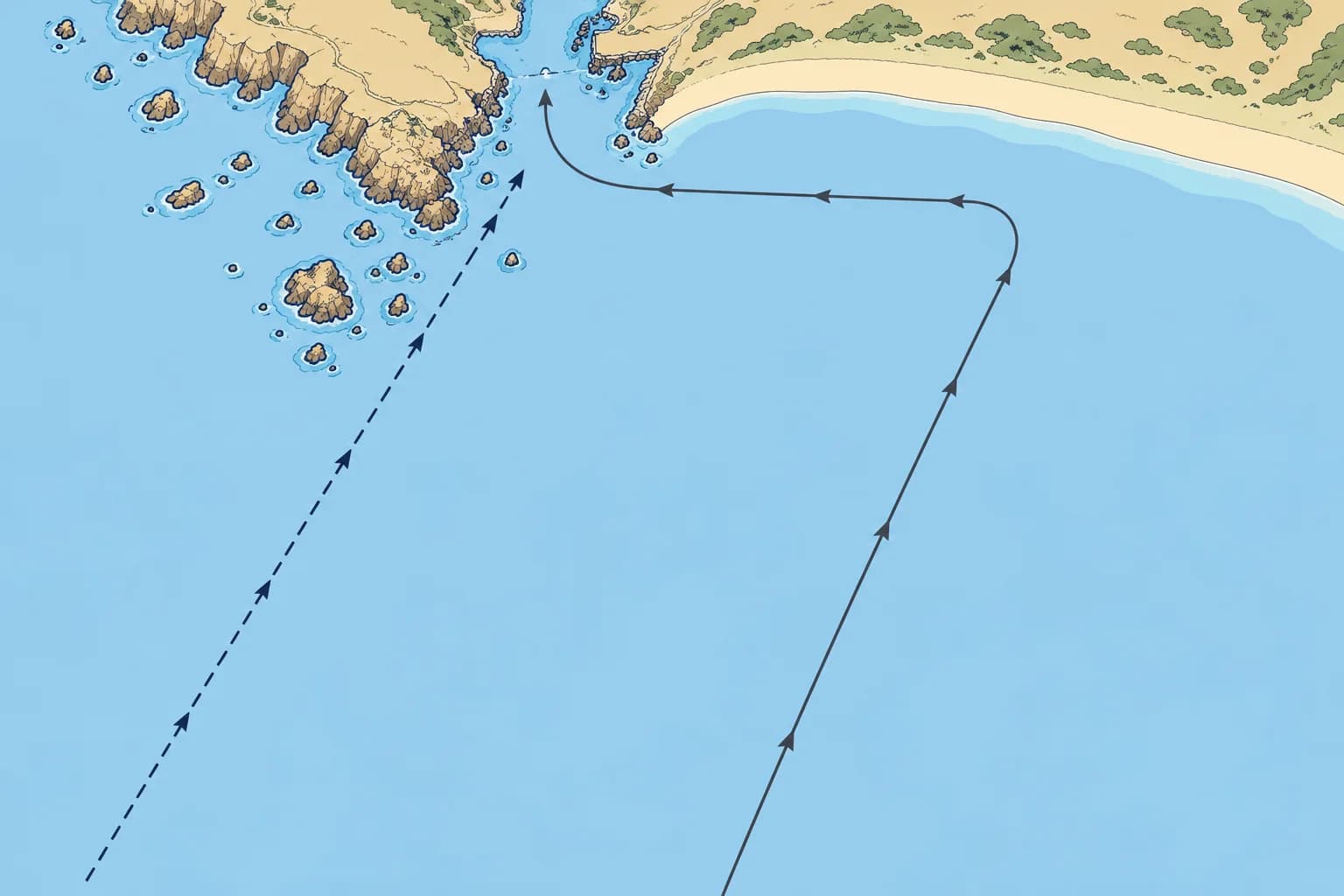
Assess uncertainty
After many hours of dead reckoning, estimating position from course, speed and time, or if satellite positioning (GNSS) fails, your position may be miles out. Reliable, checked fixes can reduce that uncertainty. Assess the remaining error before landfall. Choose a coast with clear, high features or a strong light, deep water close in and few offshore dangers. Approach from safe water where the estimated error will not put you in danger.
Aiming off
Aiming off means planning a landfall on a known safe side of your target. Choose an offset larger than estimated position and track errors, allowing for current and leeway, sideways drift from wind. Suppose a charted safe offshore landfall line, parallel to a straight coast, lies 30 NM ahead perpendicularly. A ground track, your path over the seabed, 10° from that perpendicular towards the safe side reaches the line about 30 × tan 10° ≈ 5.3 NM sideways. Confirm your position from safe water before turning along the coast.
Clearing lines and contours
A clearing line is a bearing or transit (two marks in line) marking a safe-water limit: stay on its safe side. A clearing depth is a minimum sounding, usable where the charted seabed gives reliable warning. Allow for tide, draught, a safety margin and the sounder’s reference point. A depth contour joins equal charted depths. Soundings can help check your approach, but the same depth can occur elsewhere and does not clear isolated hazards. Cross-check with other position information. See Pilotage for the method.
Lights' range
A light is visible out to the lesser of its luminous range, set by its brightness and the visibility, and its geographic range, set by heights. Geographic range in nautical miles ≈ 2.1 × (√ light height + √ eye height), heights in metres. A light 49 m high seen from an eye 2.25 m up: 2.1 × (7 + 1.5) ≈ 18 NM. Watch for it rising on the expected bearing.
Timing for daylight
A night landfall on a well-lit coast can be easier: lights identify themselves by their characteristics. Entering an unfamiliar or poorly lit harbour, or a coast with rocks, is best by daylight. Plan your speed so that you arrive with light, or stand off safely at sea until dawn. A rested crew is part of the timing.
Key figures
- Aim-off: perpendicular distance × tan(ground-track angle)
- 30 NM × tan 10° ≈ 5.3 NM; offset must exceed estimated errors
- Geographic range
- ≈ 2.1 × (√ light height m + √ eye height m) NM
- Visible range of a light
- The lesser of luminous and geographic range
- Spanish terms
- Recalada, alcance luminoso, alcance geográfico, veril
Remember
- Assess position uncertainty before landfall; plan an approach that tolerates it.
- Aim off to a charted safe side; the offset must exceed estimated position and track errors. Confirm your position before turning.
- A light shows at the lesser of its luminous and geographic range.
- Arrive with daylight at an unfamiliar or rocky entrance, or stand off until dawn.
Common mistakes
Wrong: Assume a fixed 10° aim-off guarantees which side you will reach.
Right: Choose a charted safe side and an offset larger than estimated position and track errors, allowing for current and leeway. Confirm your position from safe water before turning.
Wrong: A light with a 25 NM range will be seen at 25 NM.
Right: Its height and yours may limit it to less. Use the lesser of the luminous and geographic ranges.
Worked case
After 36 hours with no GNSS, your estimated position is 25 NM from a harbour that lies between a rocky headland to the north and a long sandy coast to the south. It will be dark in four hours. How do you plan the landfall?
Show the answer
Do not assume 10° is enough after 36 hours without GNSS. Choose a southern offshore landfall line only if charts and conditions show safe water. Make the offset exceed estimated position and track errors, allowing for current and leeway. Confirm your position independently before turning north. Check approach depths and light identities. Use your speed to recalculate arrival time. If daylight or reliable identification is doubtful, stand off in safe water until dawn.
Practice question
With an offset exceeding estimated position and track errors towards a charted safe side, why aim off at landfall?
- So the tide is always behind you on arrival
- So the passage is as short as it can possibly be
- So you always arrive exactly in daylight
- So you know which way to turn at the coast
Show the answer
Answer: D. An offset larger than estimated position and track errors, allowing for current and leeway, puts your planned landfall on a known safe side. Confirm your position from safe water before turning along the coast.
5 · OSR & checklist
Offshore categories and the passage checklist
World Sailing's Offshore Special Regulations grade races from Category 0 to 4. They are a useful benchmark for preparing any offshore passage.
What the OSR are
World Sailing's Offshore Special Regulations (OSR) set minimum equipment and training for offshore races. The 2026–2027 edition took effect on 1 January 2026; check for later versions before using it. A race organiser chooses the category. They are rules for racing, but cruising sailors and schools use them as a benchmark.
Categories 0 to 2
Category 0: trans-ocean races, including cold areas (air or sea below 5 °C other than temporarily), where boats must be fully self-sufficient for very extended periods and ready for heavy storms and serious emergencies without outside help. Category 1: long races well offshore, with the same self-sufficiency for extended periods. Category 2: races of extended duration along or not far from shorelines, or in large unprotected bays or lakes, needing a high degree of self-sufficiency.
Categories 3 and 4
Category 3: races across open water, mostly relatively protected or close to shorelines. Category 4: short races close to shore, in relatively warm or protected waters, normally in daylight. Separate appendices cover inshore racing.
Examples of what changes
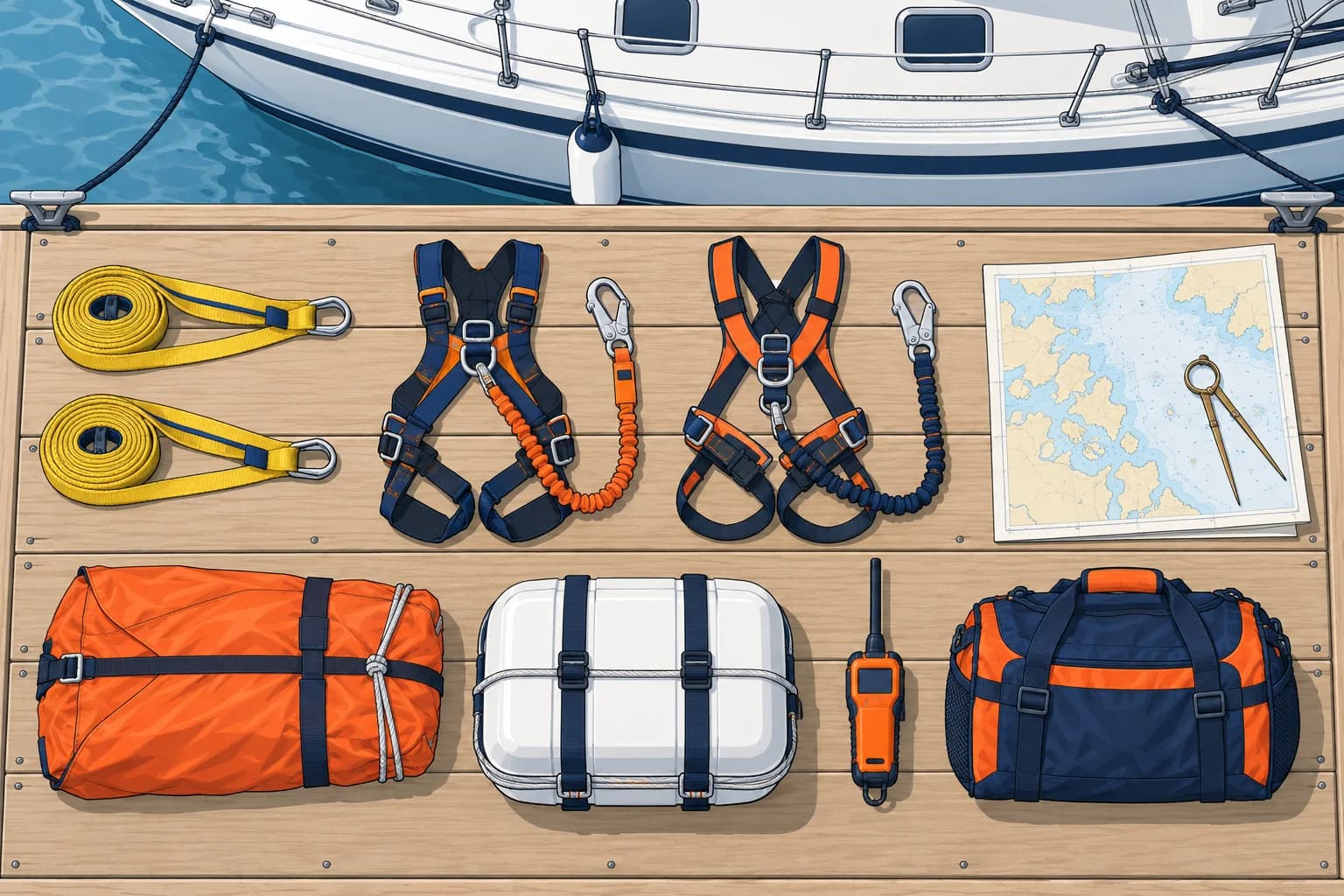
Requirements rise with the category. For Categories 0 to 3 the OSR require fixed jackstays and clipping points, a harness and tether for each crew member, and paper charts, not electronic only. Category 0 adds an active radar target enhancer. Storm sails differ by category; the Reefing and rigging unit lists them.
Your own checklist
Before an offshore passage, work through the boat, the crew, the plan and the communications. The procedure below adds the offshore points to the Passage planning unit's APEM plan and the Safety equipment unit's kit.
Key figures
- OSR edition
- 2026–2027, effective 1 January 2026 (check for later versions)
- Categories
- 0 trans-ocean; 1 well offshore; 2 near shore, extended
- Lower categories
- 3 open water, fairly protected; 4 short, normally daylight
- Spanish licence distance limits
- Patrón de Yate: 150 NM from coast; Capitán: no distance limit
Offshore passage checklist (adds to the APEM plan)
- Compare the boat and kit with the OSR category that matches the passage. — It gives an independent, tested standard for equipment and preparation.
- Plan watches, standing orders and the skipper's rest from departure. — Fatigue grows over days; landfall needs a rested skipper.
- Rig jackstays, check navigation lights, and prepare reefs and storm sails before dark. — Jobs that are easy in daylight are hard and risky at night.
- Plan the landfall: aim-off side, clearing lines, lights and daylight timing. — Near land, a position error can put you close to danger.
- Brief the crew on the man-overboard, fire, flooding and abandon-ship plans. — Offshore you must manage serious emergencies without quick outside help.
- Leave the plan, crew list and expected arrival with a shore contact. — Someone knows when to raise the alarm if you are overdue.
Remember
- OSR Categories 0–4 range from trans-ocean races to short coastal races normally held in daylight.
- The OSR are racing rules but a good benchmark for cruising offshore.
- Categories 0–3 require jackstays, harnesses and tethers, and paper charts.
- Add watches, night preparation, landfall and a shore contact to the APEM plan.
Common mistakes
Wrong: The OSR are law for every yacht going offshore.
Right: They apply to races that adopt them. For cruising they are a voluntary benchmark; your flag state sets the legal rules.
Wrong: Category 4 kit is enough for a 300 NM crossing.
Right: Category 4 is for short coastal races, normally in daylight. Match the category to the passage.
Worked case
A friend plans a 400 NM crossing well offshore with three days at sea, and says his boat is fine because it passed the safety check for a Category 4 club race. What do you suggest?
Show the answer
Category 4 is for short races close to shore, normally in daylight. A three-day passage well offshore is closer to Category 1 or 2, depending on how far from shore it runs. Compare the boat with that category's list: jackstays, harnesses and tethers, paper charts, liferaft, beacons, storm sails. Then add a watch plan, night preparation, a landfall plan and a shore contact.
Practice question
Which OSR category covers short races close to shore, normally in daylight?
- Category 1
- Category 2
- Category 3
- Category 4
Show the answer
Answer: D. Category 4 is for short races close to shore in relatively warm or protected waters, normally in daylight.