
Navigation · Level R3 · 5 parts · about 16 min
Passage planning: appraise, plan, execute and monitor
5 short parts: The four stages · Appraise · Plan · Weather windows · Execute, monitor. Each part explains the idea, then gives the points to remember, the common mistakes, a worked case and a practice question; the Academy unit adds all 31 check questions.
1 · The four stages
The four stages of a passage plan and the rule behind them
Every passage is planned before you leave: appraise, plan, execute and monitor. The rule is in SOLAS, and the depth of the plan grows with the trip.
What a plan is
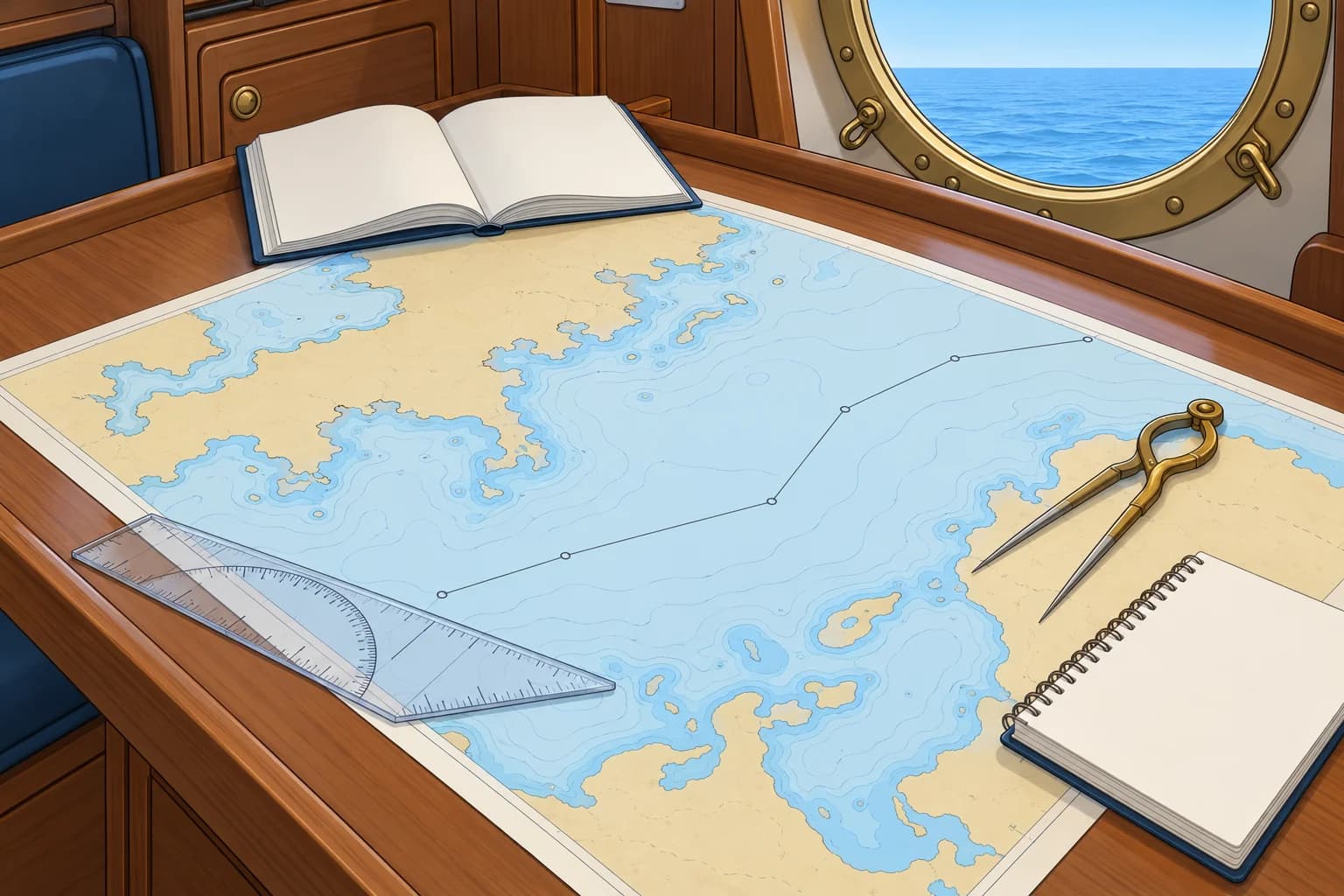
A passage plan is your route and timing, worked out before you leave, with the dangers, tides, weather and options along the way. It lets you make the hard decisions calmly in harbour, not tired at sea. Inquiries into groundings and rescues keep finding the same cause: no plan, or a plan nobody checked.
The four stages
The International Maritime Organization (IMO) Guidelines for voyage planning (Resolution A.893(21), 1999) divide the work into four stages, often called APEM. Appraise: gather all the information. Plan: draw the route and set the timings, berth to berth. Execute: carry it out, adjusting to the real conditions. Monitor: check progress against the plan all the way. The guidelines are written for ships, but each stage scales down to a day sail.
The rule
SOLAS (the International Convention for the Safety of Life at Sea) chapter V applies to all ships on all voyages unless a regulation says otherwise. Its regulation 34 says the person in charge must plan the voyage before going to sea, using suitable charts and publications. The UK applies this expressly to pleasure craft. Other states apply it in their own ways, but every skipper course, from PER to Day Skipper, expects a plan.
How much planning
The UK guidance says the depth of the plan depends on the size of the boat, the crew and the length of the trip. It lists the points to cover: weather, tides, the limitations of the vessel, the crew, navigational dangers, a contingency plan and information ashore. In the UK, "going to sea" means leaving categorised waters such as harbours and estuaries, but the advice is to plan every trip.
Short or long
For a short trip in known waters, the plan may be a few notes: tide times, the forecast, a bolt-hole (a nearby shelter) and the time you expect back. For a coastal passage, write down each leg (route section), waypoint (planned position), tidal gate (place passed at suitable tide times), arrival time, expected light and refuge. Either way, it exists before you leave the berth.
Key figures
- The four stages
- Appraise, Plan, Execute, Monitor (APEM)
- IMO guidelines
- Resolution A.893(21), Guidelines for voyage planning
- The rule
- SOLAS chapter V, regulation 34: plan before going to sea
- UK small-craft checklist
- Weather, tides, vessel, crew, dangers, contingency, ashore
Remember
- APEM: appraise, plan, execute, monitor, from IMO Resolution A.893(21).
- SOLAS V/34 requires a voyage plan before going to sea; the UK applies it to pleasure craft.
- The plan grows with the boat, the crew and the trip, but it always exists.
- Cover weather, tides, boat, crew, dangers, a contingency plan and someone ashore.
Common mistakes
Wrong: Passage planning is only for ships and long offshore trips.
Right: SOLAS chapter V applies to all ships, and the UK applies regulation 34 to pleasure craft. A short trip needs a short plan, not none.
Wrong: The plan is done once the route is drawn on the chart.
Right: Drawing the route is only the second stage. Executing and monitoring it at sea are part of the plan too.
Wrong: Planning means following the plan whatever happens.
Right: A good plan includes its own way out: bolt-holes, abort points and a contingency plan for when conditions change.
Worked case
A friend plans a 25 nautical miles (M) coastal hop tomorrow on your boat. He says it is "only a day sail" and he will "check the weather in the morning". Nothing else is planned.
Show the answer
Even a day sail needs a plan. Appraise tonight: forecast, tide times and streams, the charts and pilot notes, the crew and the boat. Plan the route with waypoints, the timing for any tidal gate, one or two bolt-holes and a contingency. Tell someone ashore when you expect to arrive. In the morning, check the latest forecast against your limits, then execute and monitor.
Practice question
What are the four stages of passage planning, in order?
- Plan, appraise, monitor, execute
- Appraise, execute, plan, monitor
- Execute, monitor, appraise, plan
- Appraise, plan, execute, monitor
Show the answer
Answer: D. IMO Resolution A.893(21): appraise the information, plan the route, execute the plan, monitor progress.
2 · Appraise
Appraise: gathering the information
Collect everything that affects the passage before you draw a line: charts and books, tides, weather, the boat, the crew and the dangers on the way.
Charts and publications
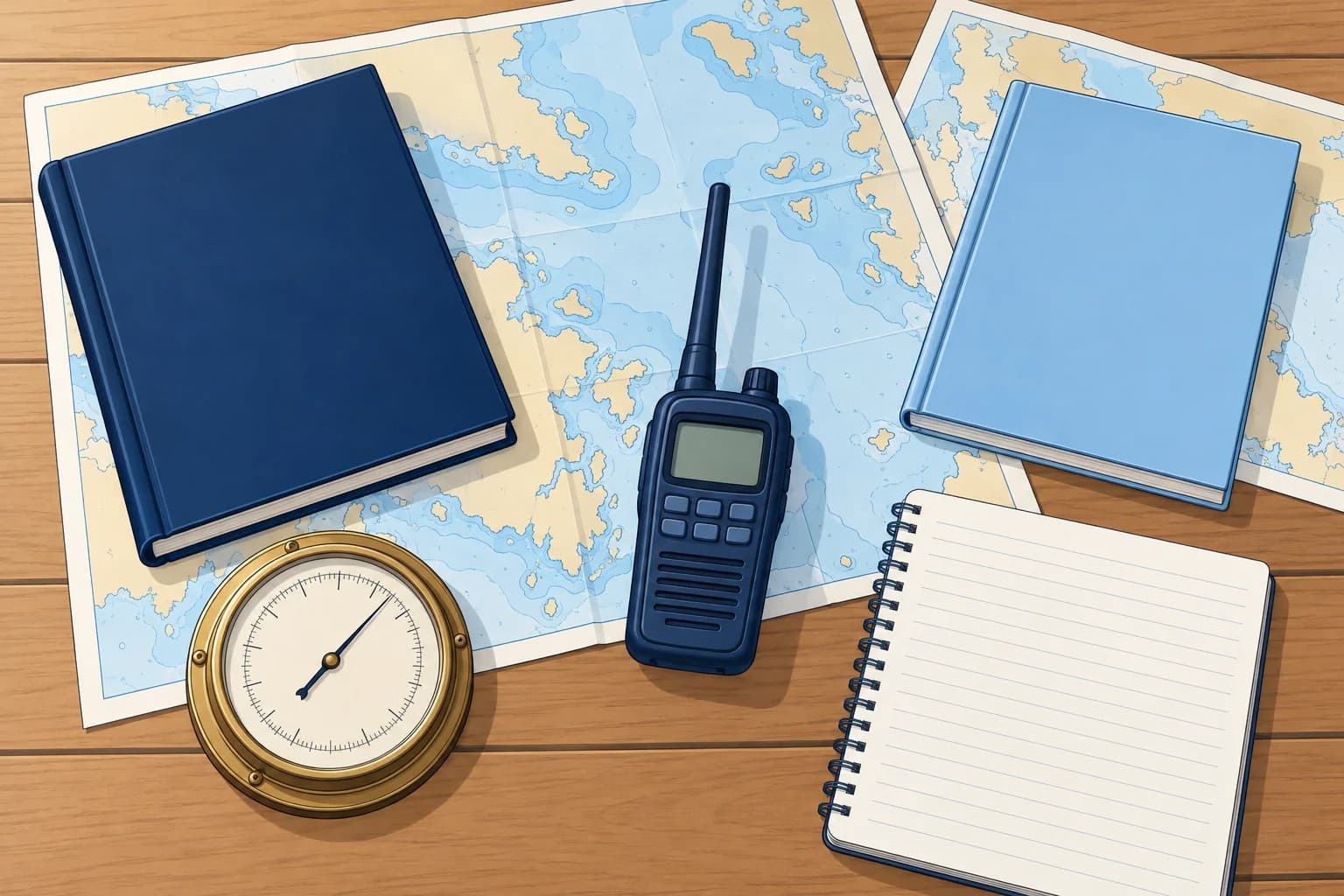
Collect charts for the whole route, including large-scale charts (detailed views of a small area) of departure, destination and refuges. Apply Notices to Mariners (official chart corrections). Add a cruising almanac, such as Reeds (tide tables, lights, radio and port information), a pilot book or sailing directions (local advice on hazards, harbours and anchorages), and a tidal stream atlas (maps of stream direction and speed).
Tides and streams
Find the times and heights of high and low water, and whether it is springs or neaps. Look up the direction and rate of the streams along the route. They decide when you can leave, cross a bar or enter a harbour, and how fast you will really go over the ground. The Tides and heights and Tidal streams units show the calculations.
Weather
Get the official forecast for the whole passage plus a margin, and the outlook beyond it. Note the wind strength and direction over time, sea state, visibility and any warnings. Plan when and how you will get the next forecast at sea. The Weather windows part shows how to decide.
The boat
Is she fit for this trip? Check engine, fuel and range, water, batteries, rigging, sails, safety equipment and spares. Know her limits: the wind and sea she handles well with this crew, her speed under engine into a head sea, and her draft (depth below the waterline) and air draft (height above it) for every bar and bridge.
The crew
Count who can steer, navigate and handle the boat if you are hurt. Think about experience, fitness, seasickness, cold and tiredness. A passage that suits four experienced sailors can be too much for a couple with one novice. Ask about medical conditions and medicines.
Dangers and rules
List the hazards: rocks, shoals, overfalls, traffic separation schemes (one-way lanes for ships), ferry routes, firing ranges, wind farms, fish farms and navigational warnings, including GNSS (satellite navigation) interference. Check local rules such as speed limits, protected areas and anchoring bans.
Key figures
- Charts
- Whole route, plus large scale for ports and refuges; corrected
- Publications
- Almanac, pilot book, tidal stream atlas, list of lights
- Tides
- High/low water (HW/LW), springs/neaps, stream rates
- Boat limits
- Wind and sea, engine range, draft, air draft
Remember
- Use corrected charts for the whole route, with large-scale charts of every port you may enter.
- The almanac, pilot book and stream atlas complete the chart.
- Tides and streams often decide when you can leave and arrive.
- Judge the boat and the crew honestly: the weakest link sets the limit.
- List every danger and local rule along the route before you plan it.
Common mistakes
Wrong: Carry a small-scale chart of the whole coast; the plotter has the detail.
Right: Carry large-scale charts or a chart book of the departure, destination and refuges, in case the electronics fail.
Wrong: Plan for the crew at their best.
Right: Plan for them tired, cold and seasick. A passage must still be safe if one person cannot help.
Wrong: The forecast for the morning is enough for a day passage.
Right: Get the forecast for the whole passage plus a margin, and plan when you will get the next update.
Worked case
You plan a 40 M passage along an unfamiliar coast, with a tidal headland halfway and a harbour with a bar at the end. Your crew are your partner, who can steer, and a friend on her first trip.
Show the answer
Check chart corrections, warnings, the headland’s stream and the bar’s depth and entry limits before deciding. Confirm fuel and boat fitness. Your partner can steer, but do not assume either crew member can navigate or manage an emergency. Choose timing and a usable refuge you can manage if one becomes seasick; shorten or postpone if you cannot.
Practice question
Where would you look first for local advice on a harbour's approach, hazards and berths?
- The tidal stream atlas
- The pilot book
- The list of radio signals
- The deviation card
Show the answer
Answer: B. Pilot books and sailing directions describe harbours, approaches, hazards and anchorages in words and plans.
3 · Plan
Plan: the route, the timings and the way out
Draw the route berth to berth with safe margins, time it around the tidal gates, choose your bolt-holes and abort points, write it down and tell someone ashore.
Draw the route
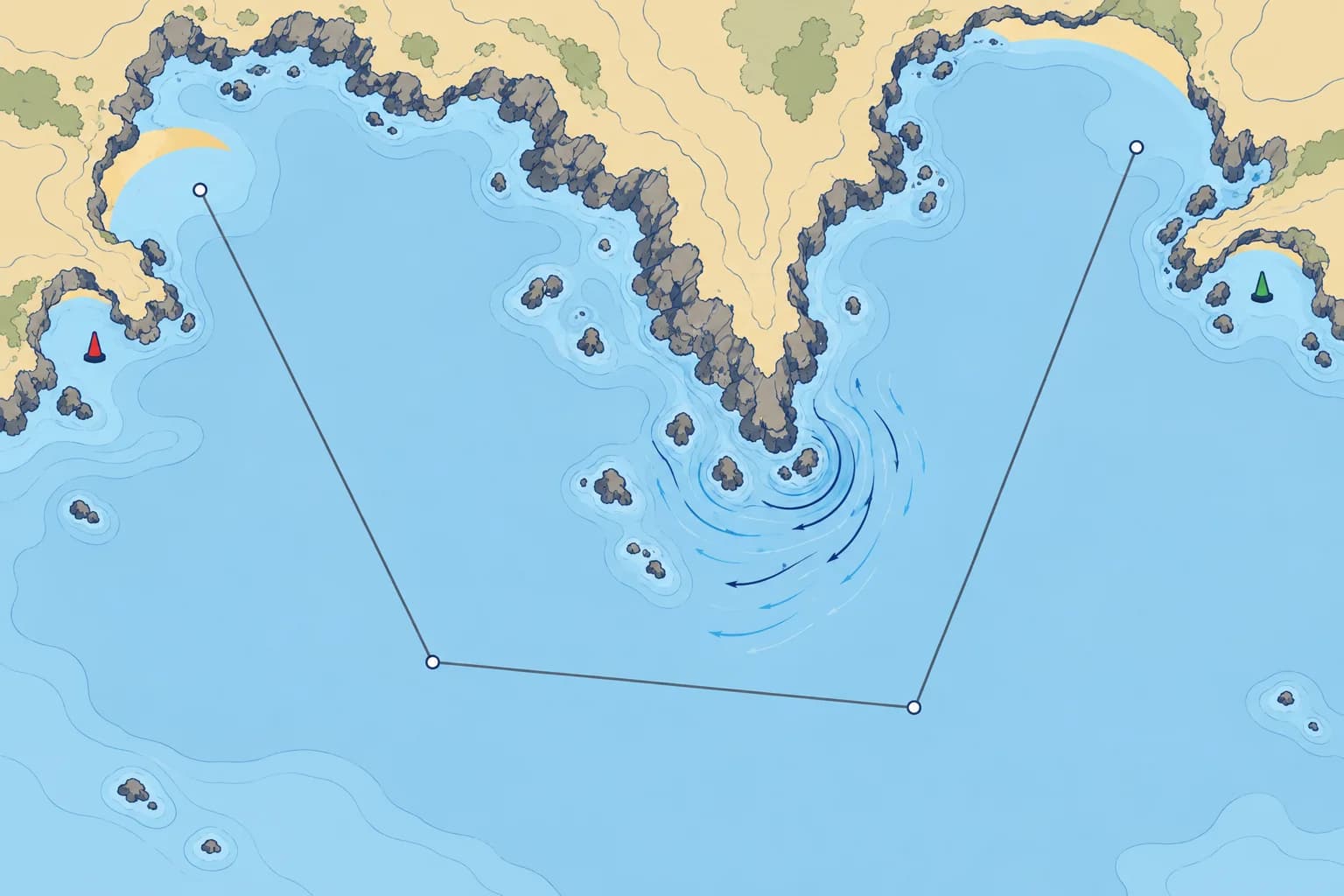
Draw the route on the chart, berth to berth and leg by leg. Keep a clearance margin from every danger, larger at night, in poor visibility, over poorly surveyed areas and wherever the wind or stream could push you towards it. Mark no-go areas clearly. Allow for tide height, water below the keel and overhead clearance. Check every planned leg against the chart, including the departure and arrival approaches.
Timing and tidal gates
A tidal gate is a place you can only pass safely at certain states of the tide: a headland with strong streams, a bar, a lock or a shallow channel. Work the timing backwards from the gates: when must you be there, so when must you leave? Use a realistic average speed over the ground (speed relative to the seabed), allowing for streams, and add a time margin.
Bolt-holes and abort points
Mark ports of refuge, or bolt-holes: places you can enter in the expected wind and tide, by day or night. Note their limits: a harbour with a bar can be dangerous to enter in strong onshore winds. Choose abort points, positions or times where you will turn back or divert if you are late or conditions are worse than planned.
Arrival and the night
Prepare the pilotage for departure and arrival: marks, transits and clearing bearings (the Pilotage unit shows how). On a night passage, list the lights you expect to see and roughly when. Note the VHF channels of ports and the coastguard, and where you will meet heavy traffic.
Write it down and tell someone
Put the plan where the crew can see it: legs with courses and distances, the waypoint list, tide times, gates, refuges, ETA (estimated time of arrival) at each gate and port and VHF channels. Leave the plan with a responsible person ashore, and agree when they should call the coastguard if you have not arrived. Some coastguards also offer free voluntary registration or route-sharing apps; use them where they exist.
Key figures
- Planning speed
- Realistic average speed over the ground, allowing for the stream
- Work back from
- The tidal gates: when you must be there
- Clearance margin
- Larger at night, in poor visibility and over old surveys
- Refuge test
- Can you enter it in the expected wind, tide and darkness?
- Shore contact
- Knows the plan, the ETA and when to call the coastguard
Remember
- Draw the route berth to berth with clear margins from every danger.
- Time the passage backwards from the tidal gates, at a realistic speed.
- Choose bolt-holes you can enter in the expected conditions, and set abort points.
- Prepare the pilotage and the night lights before you leave.
- Write the plan down and leave it with someone ashore who knows when to raise the alarm.
Common mistakes
Wrong: Choose a departure time without checking the tidal gates.
Right: Check that your arrival falls within each gate’s safe window. Work backwards when a gate determines your departure time.
Wrong: Any harbour on the route counts as a refuge.
Right: A refuge must be safe to enter in the conditions you expect. A bar harbour in an onshore gale is a trap.
Wrong: Tell someone ashore you are going sailing.
Right: Give them the route, the ETA and a clear time at which to call the coastguard if you have not checked in.
Worked case
A headland is 18 M away. Its safe tidal window is 1200–1400. Your planned average speed over the ground is 5 kn (knots). A refuge 6 M short of it is usable today. You can leave at 0900 or 1100. Allow 30 minutes for delay. Which departure works, and what will trigger a diversion?
Show the answer
At 5 kn over the ground, 18 M takes 3 h 36 min. Leaving at 0900 gives an ETA of 1236, or 1306 with the delay margin. Leaving at 1100 gives 1436, outside the window. Choose 0900. Before leaving, set a decision point before the refuge: if your updated headland ETA plus 30 minutes exceeds 1400, divert while the refuge remains reachable.
Practice question
What is a tidal gate?
- A lock gate that keeps water in a marina
- A point you can pass well only at some tide states
- A buoy that marks the edge of a strong tidal stream
- A time when the tidal stream stops for several hours
Show the answer
Answer: B. A headland, bar, lock or channel you can only pass sensibly at certain states of the tide. A lock can be one example, but the term is wider.
4 · Weather windows
Weather windows and go/no-go decisions
Set your limits before you read the forecast. Go only if the window is long enough with a margin, and plan around wind against tide.

A weather window
A weather window is a period long enough, with conditions within the limits of your boat and crew, to complete the passage with a margin. For an 8-hour passage, look for several more hours of acceptable weather, and check what follows the window: you may need shelter at the other end.
Set your limits first
Decide your go/no-go criteria before you read the forecast, so that hope does not decide for you. For example: no more than force 5 for this crew, no strong headwind on the long leg, visibility above 2 M, and no gale warning for the area. Gusts are often a third to a half above the mean wind, and more in squalls (sudden bursts of strong wind). Use forecast gust values where available; rough mean-to-gust ratios are not upper limits.
Wind against tide
Wind blowing against a tidal stream raises short, steep seas, worst off headlands, over shallow banks and in tidal races (areas of fast, turbulent stream). A force 4 can become dangerous for a small boat there. Avoid wind against tide at headlands and races. At bars (shallow banks across entrances), also check swell, breaking seas, depth and local advice: slack water or wind with tide does not guarantee a safe crossing. The Tidal streams unit covers timing.
Sources and updates
Use official forecasts: the national met service's coastal and inshore forecasts, coastguard VHF broadcasts and NAVTEX (official maritime safety text broadcasts). Weather apps built from one computer model can miss local effects such as sea breezes and wind speeding up round headlands, so compare more than one source. Know when the next forecast is issued and get it at sea. The Meteorology module explains forecasts.
Watch the trend
Before and during the passage, compare the wind, sky, swell and pressure trend with the forecast and your limits. Falling pressure can be forecast; it alone does not prove an error. If conditions worsen sooner than expected, get an update and reassess your remaining margin. Divert early if your limits or safe arrival are threatened, while a planned refuge is still safe to enter.
Key figures
- Window length
- Passage time plus a margin, and a look at what follows
- Gusts
- Often a third to a half above the mean wind
- Wind against tide
- Short steep seas: worst off headlands, banks and races
- Official sources
- Met service forecasts, coastguard VHF, NAVTEX
Remember
- Set go/no-go limits before you read the forecast.
- A weather window must cover the whole passage plus a margin.
- Plan for gusts above the forecast mean wind.
- Avoid wind against tide at headlands, bars and races.
- Compare conditions with the forecast and your limits; divert early if limits or safe arrival are threatened.
Common mistakes
Wrong: Read the forecast first, then decide what is acceptable.
Right: Set your limits first. Otherwise a keen crew talks itself into conditions it would never have chosen.
Wrong: Force 4 is always comfortable sailing.
Right: Against a strong tidal stream off a headland, force 4 can raise short, steep and dangerous seas.
Wrong: One weather app is enough.
Right: Use official forecasts and compare sources. Single-model apps can miss local winds and timing.
Worked case
Your 30 M passage takes 6 hours at 5 kn over the ground. Your crew’s wind limit is force 4. SW force 4 lasts until 1800, with force 6 from 2100. The headland is 15 M away, with a NE-going stream from 1000 to 1600. Your destination and refuge remain sheltered. You can leave at 0800.
Show the answer
Leaving at 0800 puts you at the headland about 1100 and in harbour about 1400, four hours before the force-4 period ends. SW wind blows towards NE, with the stream. Go only if the latest forecast, gusts, sea state, visibility, boat and crew meet your limits and arrival shelter remains usable. Set an abort check before the headland and divert early to a refuge still safe to enter if timing or conditions threaten your margin.
Practice question
When should you set your go/no-go criteria for a passage?
- After reading the morning forecast
- When the crew have voted on it
- Once you are clear of the harbour
- Before you look at the forecast
Show the answer
Answer: D. Limits set in advance stop wishful thinking. They should reflect the boat and the weakest crew member.
5 · Execute, monitor
Execute and monitor: sailing the plan
Brief the crew, check the boat, then sail the plan while checking it all the way. Change it early when an assumption fails.

Before departure
Get the latest forecast and compare it with your go/no-go criteria. Brief the crew: route, timings, watches, hazards, lifejackets and harnesses, the man-overboard routine and where the safety kit is. Check the engine, fuel and instruments, and that the plotter route matches the paper plan. Tell your shore contact you are leaving.
Execute
To execute is to sail the plan in the real conditions. The plan gave times; now the wind, the stream and the boat’s speed decide the real ones. Update the ETAs at tidal gates as you go. If early, slow down or wait somewhere with safe sea room. Pass only while depth, stream and sea conditions meet your limits. If you cannot wait safely or will miss the window, use your planned diversion.
Monitor
To monitor is to check progress throughout. Fix by more than one method at intervals short enough to detect an error and act before reaching danger; shorten them as speed or uncertainty increases. Log each fix and compare it with the plan. Watch your cross-track error (XTE), the sideways distance from your planned track. Compare depth and clearing bearings with the plan during pilotage. Check the weather against the forecast at each update.
When to change the plan
Change the plan as soon as a key assumption fails: wind or sea beyond your limits, a tidal gate you will miss, a seasick or injured crew member, or gear failure. Decide at your planned abort points, before you are committed off a lee shore (a coast the wind blows towards). A diversion is part of good planning, not a failure.
Arrival and afterwards
Prepare the arrival before you reach the entrance: lines and fenders ready, marks identified, VHF call made. Once in, tell your shore contact you have arrived. Note in the log what differed from the plan; it improves the next one.
Key figures
- Fix interval
- Short enough to detect errors and act before reaching danger
- Execute
- Sail the plan; update ETAs at each gate
- Monitor
- Fixes, XTE, depth, weather against the plan
- Change the plan when
- Weather, timing, crew or boat breaks an assumption
Departure checklist
- Check the latest forecast against your go/no-go criteria. — The decision to go uses the newest information, judged by limits set in advance.
- Brief the crew on route, watches, hazards and emergency routines. — Everyone knows the plan and what to do if the skipper is hurt.
- Check engine, fuel, instruments, navigation lights and safety kit. — Faults are easier to fix alongside than at sea.
- Compare the plotter route with the paper plan, leg by leg. — A wrong waypoint caught now cannot lead you into danger later.
- Tell your shore contact your departure time and ETA. — The alarm time they hold only works if they know when you left.
Remember
- Check the forecast, brief the crew and check the boat before you leave.
- Update ETAs at every tidal gate as the real speeds become clear.
- Choose fix intervals by speed, uncertainty and time to danger; cross-check by another method.
- Change the plan early, at your abort points, when an assumption fails.
- Tell your shore contact when you leave and when you arrive.
Common mistakes
Wrong: Stick to the plan's times even if the boat is slower than expected.
Right: Update the ETAs as you go. A late arrival at a gate may mean a foul stream, so adjust or divert.
Wrong: Fix your position only when something looks wrong.
Right: Choose fix intervals that leave time to detect an error and act before danger. Cross-check by another method.
Wrong: Turning back means the plan has failed.
Right: A diversion at a planned abort point is the plan working. Pressing on beyond your limits is the failure.
Worked case
Two hours into a 35 M passage, your average speed over the ground is 4 kn instead of the planned 5.5 kn into an unforecast head sea. The tidal gate at the headland closes in 4 hours, and it is 18 M away. One crew member is seasick.
Show the answer
At 4 kn, 18 M takes 4.5 hours: you would reach the headland after the gate closes. A key assumption has failed and the crew is weaker. Divert to the planned bolt-hole while it is safe to enter, or turn back if that route is safe. Tell your shore contact the new ETA. Log the change and why.
Practice question
Before departure, a crew member cannot find the lifejackets or explain their emergency role. What do you do?
- Delay the briefing until you have left the harbour
- Tell them to copy the other crew during an emergency
- Give written notes instead of explaining their role
- Explain the kit and rehearse roles before leaving
Show the answer
Answer: D. Brief the crew and check they understand before you leave. Show where the kit is and rehearse their roles; imitation or written notes alone do not establish readiness.