
Navigation · Level P3 · 5 parts · about 16 min
Gyro compass, repeaters and compass error checks
5 short parts: How it works · Gyro errors · Repeaters · Error checks · Error book. Each part explains the idea, then gives the points to remember, the common mistakes, a worked case and a practice question; the Academy unit adds all 30 check questions.
1 · How it works
How a gyro compass finds true north
Gyroscopic inertia holds the spin axis steady. Gravity control and damping make the gyro settle on the true meridian, the north–south line.
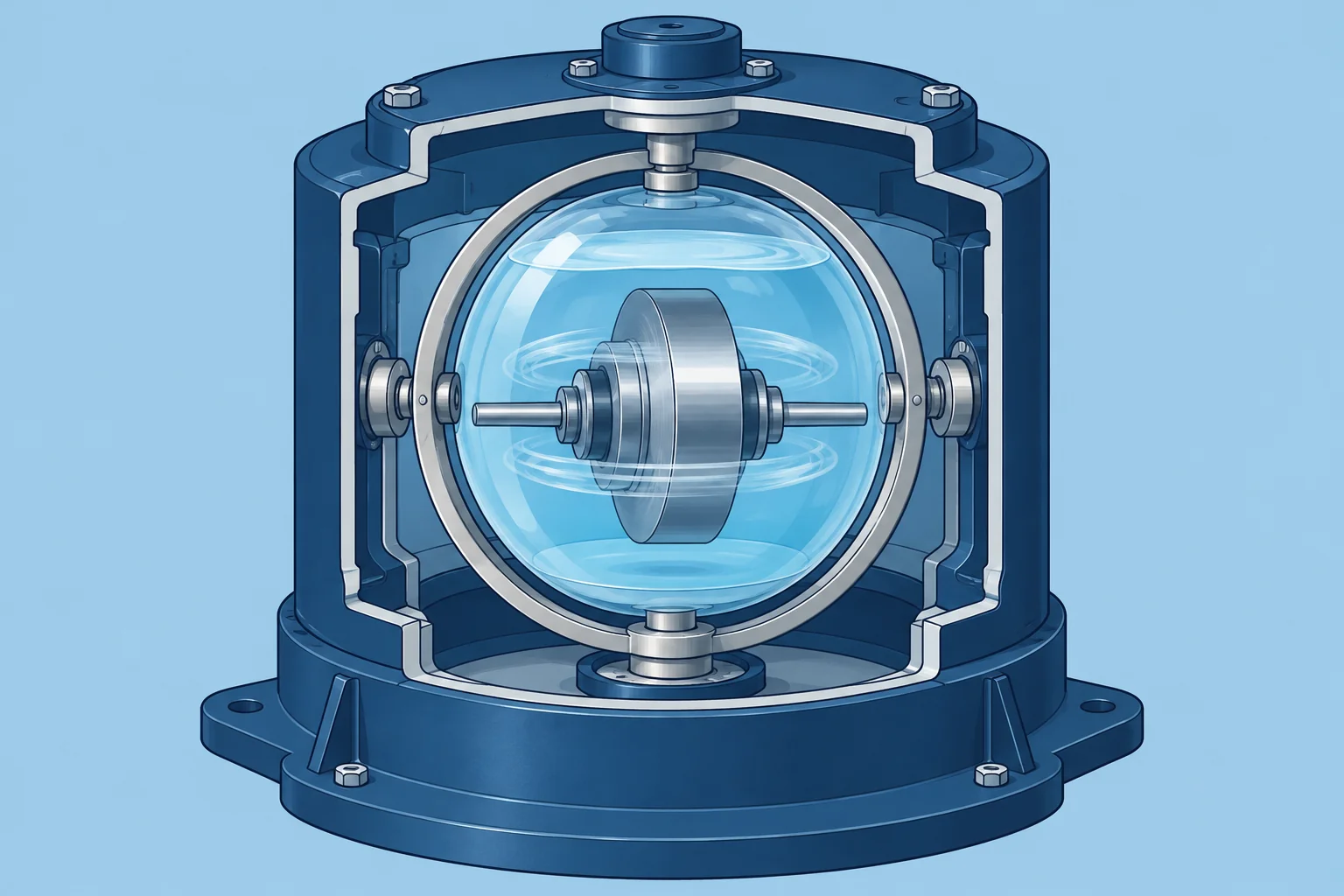
Two properties
A gyroscope is a fast-spinning rotor free to turn about its axes. Gyroscopic inertia, or rigidity in space, means its spin axis keeps pointing in the same direction in space. A turning force, called torque, applied about one axis makes the gyro turn about a third axis. This is precession. That third axis is at right angles to both the spin axis and the torque axis. A gyro compass uses both properties.
Why a free gyro wanders
The Earth turns about 15° an hour. A free gyro holds its direction in space while Earth turns beneath it. For a horizontal axis, drift in azimuth (horizontal direction) is about 15° × sin φ per hour, where φ is latitude. Tilt depends on axis direction: its maximum rate is about 15° × cos φ per hour, with the axis east–west; it is zero north–south. These are apparent motions, not north-seeking.
Gravity control
The maker adds gravity control: a pendulous weight or a linked liquid system. When the axis tilts, gravity produces a torque, and precession turns that torque into movement in azimuth, towards the meridian. The axis now swings to and fro across the meridian, east and west, without stopping. This makes the gyro north-seeking.
Damping and settling
Damping shrinks each swing until the axis comes to rest on, or very close to, the meridian: the gyro has settled. Settle point error is the difference between its mean settled indication and true heading. Settling takes time after switching on. The IMO performance standard, resolution A.424(XI), allows up to six hours in latitudes up to 60°. Many modern units are quicker. Switch on early, by the maker's figure, before you need the heading for departure.
Strengths and limits
A settled gyro gives true headings: no variation or deviation. Its north-seeking force grows weaker towards the poles, roughly with cos φ, so errors grow in high latitudes; check the manual for the working limit. It depends on electrical power and the rotor support. It needs a standard magnetic compass as the independent backup, and its error must still be checked.
Key figures
- Earth's rotation
- About 15° an hour (15.04° per hour)
- Free gyro drift (horizontal axis)
- About 15° × sin latitude per hour
- Free gyro maximum tilt
- About 15° × cos latitude per hour; horizontal east–west axis
- Settling time (A.424)
- Within 6 hours, latitudes up to 60°
- Settle point error (A.424)
- Not more than 0.75° ÷ cos latitude
Remember
- Gyroscopic inertia holds the axis steady in space. Precession changes its direction under an applied turning force.
- A free gyro drifts and tilts as the Earth turns. Gravity control makes it seek the meridian.
- Damping stops the swinging, so the gyro settles. Allow the maker's settling time.
- A gyro shows true north, but it weakens near the poles and still has small errors.
Common mistakes
Wrong: A gyroscope by itself points to true north.
Right: A free gyro only holds its direction in space. Gravity control and damping make it seek and settle on the meridian.
Wrong: The gyro is ready as soon as the rotor is up to speed.
Right: It must settle first, which can take hours. Switch on early and compare with the magnetic compass before relying on it.
Wrong: A gyro has no errors because it has no variation or deviation.
Right: It has small errors of its own, such as speed-and-course error, and these grow in high latitudes. Check it every watch.
Worked case
Your ship has been in dry dock with the gyro switched off. Departure is planned for 0800 and the electrician offers to start the gyro at 0730. What do you say?
Show the answer
Do not assume 30 minutes is enough. Check the maker’s settling time and readiness indications. Arrange startup early enough to meet them. Before using the gyro for departure, confirm it has settled and check its error against an independent reference.
Practice question
What is gyroscopic precession?
- Keeping the spin axis fixed in space
- Changing the spin-axis direction under a torque
- Losing rotor speed through bearing friction
- Appearing to move because the Earth rotates
Show the answer
Answer: B. Precession changes the spin-axis direction under a torque, or turning force. Inertia holds it steady in space; Earth’s rotation causes apparent drift and tilt.
2 · Gyro errors
Gyro errors: speed and course, latitude and ballistic
A moving ship makes the gyro settle a little off the meridian. Know which way, how much, and which corrector setting removes it.

Speed and course error
Your north–south movement changes the rotation sensed by the gyro, shifting its settling direction away from the true meridian. Only the north–south part of your speed matters. The resulting speed-and-course error is zero on east or west courses and largest on north or south courses. It grows with speed and with latitude. On northerly courses it is westerly: the gyro reads high. On southerly courses it is easterly: the gyro reads low.
The formula
Error size° ≈ V × |cos C| ÷ (15.7 × cos φ). V is speed over ground in knots, C is true course over ground and φ is latitude. The factor 15.7 is 900 ÷ 57.3. The absolute value, |cos C|, gives size: assign W on northerly courses and E on southerly courses. Using speed through water and heading assumes no current or leeway. For your gyro's corrector settings, use the input source specified by its maker.
Worked example
Assume no current or leeway. Speed 18 knots, course 030° T, latitude 45° N. V × cos C = 18 × 0.866 = 15.6. Divide by 15.7 × cos 45° = 15.7 × 0.707 = 11.1. Error ≈ 15.6 ÷ 11.1 ≈ 1.4° W. Uncorrected, your gyro reads about 1.4° high: true heading 030° shows about 031.4°. Setting the speed corrector to 18 knots and latitude to 45° N estimates the correction; verify the remaining error.
Latitude (damping) error
In designs damped by tilting the axis, the gyro settles slightly off the meridian. This latitude error, or damping error, grows with the tangent of latitude and changes sign between hemispheres. A latitude corrector removes it. Other designs do not have it. Your gyro's manual says which kind you have and how the correction is applied.
Ballistic deflection
When you change speed or course, the north–south acceleration acts on the gravity control. The axis is pushed off for a while: ballistic deflection. Schuler tuning sets the natural period to about 84.4 minutes. This helps the axis follow its changing settle point during a manoeuvre, reducing the temporary error. In latitudes up to 60°, A.424(XI) limits errors from a rapid 20-knot speed change to 2°, and from a rapid 180° turn at 20 knots to 3°. Check the heading after major manoeuvres.
Key figures
- Speed-error size (simplified)
- Error size° ≈ V × |cos C| ÷ (15.7 × cos φ)
- Northerly courses
- Westerly error: gyro reads high
- Southerly courses
- Easterly error: gyro reads low
- East or west courses
- No speed-and-course error
- Rapid 180° turn at 20 kn (A.424)
- Error not more than 3°, up to 60° latitude
- Rapid 20 kn speed change (A.424)
- Error not more than 2°, up to 60° latitude
Remember
- Speed-and-course error depends on the north–south part of your speed and grows with latitude.
- Northerly courses: westerly error, gyro reads high. Southerly courses: easterly error, gyro reads low.
- Set the speed and latitude correctors, or check the automatic inputs, to remove these errors.
- Ballistic deflection after large speed or course changes is short-lived. Check the heading afterwards.
Common mistakes
Wrong: Speed-and-course error is largest on east or west courses.
Right: It is zero on east or west courses and largest on north or south courses, because only the north–south part of the speed counts.
Wrong: Speed error is the same at every latitude.
Right: It is divided by cos latitude, so the same speed and course give a bigger error in high latitudes.
Worked case
No current or leeway: you steam 180° T at 20 knots in 60° N. The manual speed corrector is still at 0 knots. A colleague expects a 2.5° E error and proposes subtracting 2.5° from every gyro reading instead of updating the setting. Do you agree?
Show the answer
The predicted sign and size are right, but the action is wrong. An easterly error is added to obtain true. Set speed to 20 knots and latitude to 60° N under the maker’s instructions, then independently check the remaining error. Do not keep applying the predicted 2.5° after the corrector is updated.
Practice question
On which courses is the gyro's speed-and-course error zero?
- 000° and 180°
- 045° and 225°
- 090° and 270°
- 135° and 315°
Show the answer
Answer: C. The error depends on V × cos C. cos 90° and cos 270° are zero, so there is no north–south speed component.
3 · Repeaters
Repeaters, corrector inputs and the heading feed
The master gyro supplies bridge headings. A master or input fault can affect many systems; a repeater can be wrong on its own.
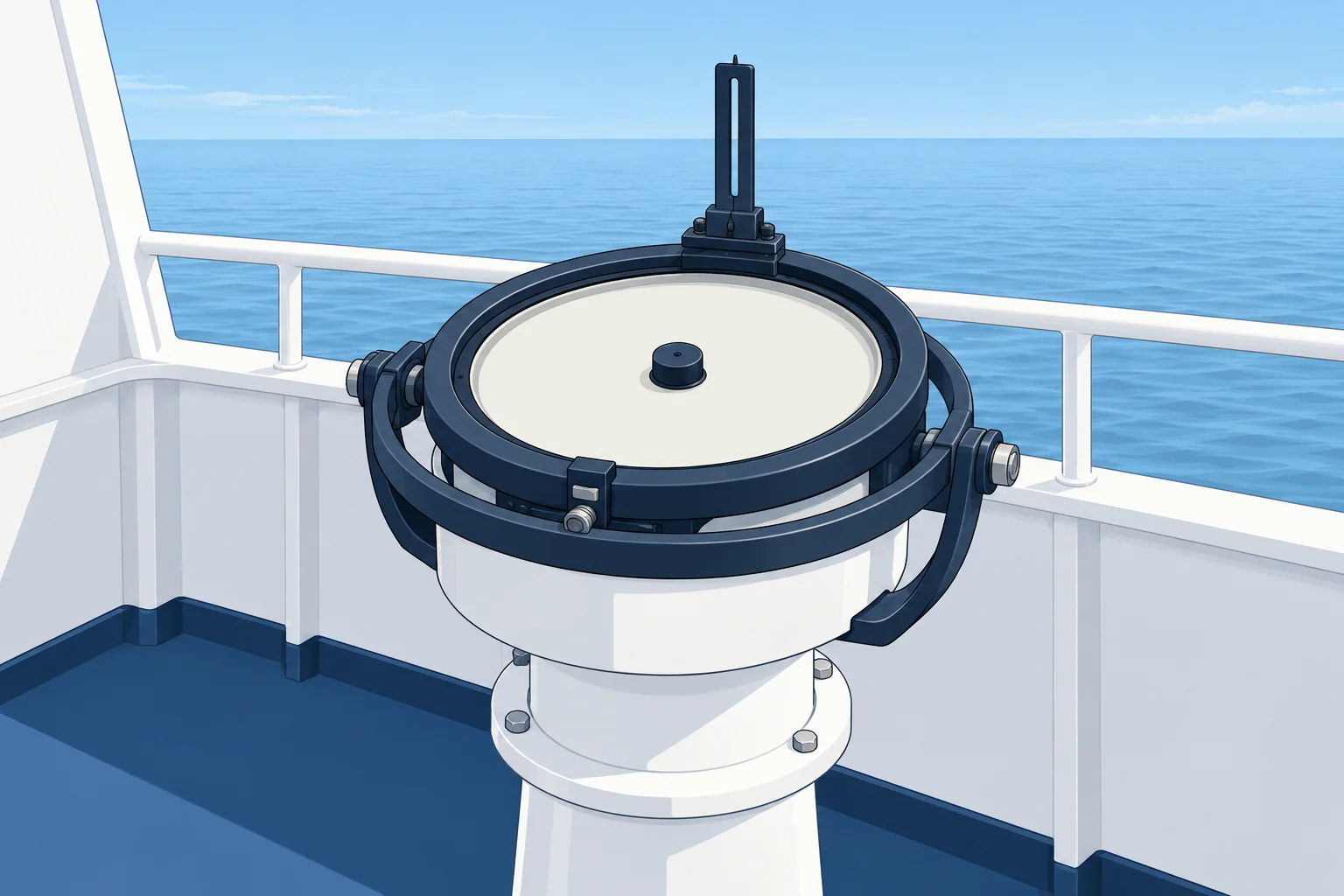
Master and repeaters
The master compass is the gyro unit. A steering repeater shows its heading at the helm; a bearing repeater lets you take bearings. SOLAS V/19.2.5.1–.3 requires ships of 500 GT (gross tonnage) and upwards to carry a gyro or other non-magnetic heading means, a heading repeater or other means giving visual heading information at an emergency steering position if fitted, and a gyro bearing repeater or other means for bearings through 360°. Below 1,600 GT, the bearing-repeater provision applies as far as possible.
Keep them aligned
A.424(XI) allows repeaters to differ from the master by not more than 0.5°. Older step repeaters can fall out of step after a power break and then show a wrong heading steadily. Compare every repeater with the master at the start of each watch, after any power interruption or alarm, and before taking bearings. Realign any that disagree, using the maker's procedure.
Corrector inputs
The speed and latitude correctors remove the errors from the previous lesson. On many gyros, speed comes from the speed log (a speed sensor) or a global navigation satellite system (GNSS); latitude comes from GNSS. The log/GNSS source and ground/water mode must match the maker's instructions. If an input is lost or wrong, the correction is wrong too. Check the values shown on the gyro's control panel each watch. If the GNSS input fails, set speed and latitude by hand as the manual describes.
Who uses the heading
Gyro heading feeds the autopilot, radar and automatic radar plotting aid (ARPA), electronic chart display and information system (ECDIS), automatic identification system (AIS), and voyage data recorder (VDR). A wrong heading can misorient heading-stabilised radar displays, misalign the radar overlay on ECDIS and mislead automatic steering. Investigate heading faults promptly.
GNSS compasses
A satellite compass, or GNSS compass, measures heading from two or more antennas. It settles quickly and has no speed error. It can be type-approved as a transmitting heading device (THD). It depends on satellite signals, so jamming or spoofing can take it away or falsify it. Treat it as a useful cross-check; whether it can replace a gyro is the flag state's decision.
Heading check at the start of the watch
- Read the master gyro heading and compare every repeater with it. — A repeater out of step gives wrong steering and bearings while looking normal.
- Check the speed and latitude values used by the gyro's correctors. — A frozen or wrong input leaves speed and latitude errors uncorrected.
- Check the latest gyro error in the compass error book. — You apply that error to courses and bearings during the watch.
- Compare gyro and magnetic headings, allowing for the checked gyro error, variation and deviation on this heading. Log the result. — An unexpected remaining difference needs an independent check; a changed raw difference alone does not prove a fault.
- Confirm the heading shown on radar, ECDIS and the autopilot. — For each system using this gyro, check that its received heading matches, allowing for any configured correction.
Remember
- Repeaters may differ from the master by not more than 0.5°. Compare them every watch.
- Check repeaters after a power break. Realign any that disagree with the master, using the manual.
- Check the speed and latitude inputs to the correctors, especially after a GNSS fault.
- A faulty shared heading feed can mislead the autopilot, radar/ARPA, ECDIS, AIS and VDR.
Common mistakes
Wrong: If the master gyro is right, every repeater must be right.
Right: Repeaters can lose step, especially after a power break. Compare each one with the master before using it.
Wrong: A satellite compass is independent of GNSS problems.
Right: It measures heading from GNSS signals, so jamming or spoofing affects it. Keep the gyro and magnetic compass as checks.
Wrong: A heading fault only matters for the helmsman.
Right: A wrong heading can misorient bridge displays, misalign the radar overlay and mislead the autopilot.
Worked case
After a short blackout and restart, the port bridge-wing repeater reads 4° more than the master gyro. The steering repeater agrees with the master. The second officer wants to take a fix by bearings from the port wing. What do you do?
Show the answer
Do not use the port repeater. First confirm that the master has settled and check its error independently. Until then, use a verified alternative heading source. Check all repeaters, corrector inputs and heading feeds. Once the master is reliable, realign the port repeater by the maker’s procedure. Use gyro bearings only after the master is verified and the chosen repeater agrees. Log and report the fault.
Practice question
What is the maximum difference between the master gyro and its repeaters allowed by A.424(XI)?
- 0.1°
- 0.5°
- 1.0°
- 2.0°
Show the answer
Answer: B. The standard allows a divergence of not more than ±0.5° under all operational conditions.
4 · Error checks
Checking gyro error: transits, celestial bearings and comparisons
Compare a known true bearing with the gyro bearing of the same thing. The difference is the gyro error. Check it every watch where you can.

The rule
STCW Code A-VIII/2 requires you to determine standard magnetic compass error at least once a watch and, when possible, after a major course alteration. Compare standard and gyro compasses frequently; keep repeaters synchronised. Check gyro error regularly under your ship’s procedures. Gyro error = true − gyro. Use the signed difference within ±180°: 001° true minus 359° gyro is +2°, or 2° E. Away from the 000° crossing, high readings mean W error; low readings mean E error.
By transit
A transit is two charted objects seen in line. Its true bearing is measured from the chart, or listed for a leading line. As the objects come in line, take the gyro bearing. This is a useful coastal check: it gives a charted true bearing without a separate position fix. Choose objects that are well separated and clearly identified, and take the bearing at the moment they line up.
Worked: by transit
From the chart, a transit of two beacons bears 052.0° T. As they come in line, the port bearing repeater reads 053.5°. Gyro error = 052.0 − 053.5 = −1.5°, that is 1.5° W: the gyro reads 1.5° high. To correct gyro readings to true, subtract 1.5°. A gyro heading of 230.0° is 228.5° T.
Other ways
At sea, use a celestial body. Its true azimuth or amplitude is calculated for the time and position; the Compass error by azimuth and amplitude unit does the working. From a known fixed position, you can compare the gyro bearing of a distant charted object with its true bearing from the chart. For a magnetic comparison, first apply known variation and deviation to obtain true heading; an independently verified GNSS compass provides another reference.
Comparing with magnetic
The same moment gives the magnetic compass error. In the example, the standard compass reads 236.0° on the heading that is 228.5° T. Magnetic compass error = 228.5 − 236.0 = −7.5°, or 7.5° W. The chart gives variation 3.0° W, so deviation = 7.5° W − 3.0° W = 4.5° W on this heading. Log it against the deviation card.
Key figures
- Gyro error
- True − gyro, wrapped to ±180°; positive = east
- Gyro reads high (away from 000°)
- Error is westerly: subtract it to get true
- Gyro reads low (away from 000°)
- Error is easterly: add it to get true
- Standard compass error (STCW)
- At least once a watch; after major turns where possible
- Deviation
- Magnetic compass error − variation
Remember
- Gyro error = true − gyro, wrapped to ±180°: positive = E (add); negative = W (subtract).
- A transit gives a reliable charted true bearing without a separate position fix: a useful coastal gyro check.
- Offshore, use an azimuth or amplitude, worked in the Compass error by azimuth and amplitude unit.
- Use a checked gyro error and current variation to derive magnetic deviation from simultaneous compass headings.
Common mistakes
Wrong: Gyro error is gyro bearing minus true bearing.
Right: Gyro error = true − gyro. With 052.0° T and 053.5° by gyro, the error is −1.5°, or 1.5° W.
Wrong: A westerly gyro error is added to gyro readings.
Right: A westerly error means the gyro reads high, so you subtract it. Add an easterly error.
Wrong: One check at departure is enough for the voyage.
Right: STCW specifies standard-compass error at least once a watch, and after major turns where possible. Check gyro error regularly under ship procedures, compare compasses frequently and log results.
Worked case
Entering port, a leading line bears 317.0° T on the chart and 315.5° by gyro. Your gyro heading is 317.5°. A colleague proposes subtracting 1.5° from gyro readings. Should you accept that, and what is the true heading?
Show the answer
No. The error is 1.5° E, so add it. Gyro error = 317.0 − 315.5 = +1.5°. The true heading is 317.5 + 1.5 = 319.0° T. Log the check with time, method and both bearings, and tell the master if the error differs from the last one.
Practice question
A transit bears 001° T from the chart and 359° by gyro. What is the gyro error?
- 2° W
- 358° W
- 2° E
- 358° E
Show the answer
Answer: C. Use true − gyro, wrapped to ±180°. The arithmetic result, −358°, is equivalent to +2° across north: the error is 2° E.
5 · Error book
The compass error book and using the results
Every check goes in the compass error book. Read the record for trends: a steady error you can apply, a sudden change you must investigate.
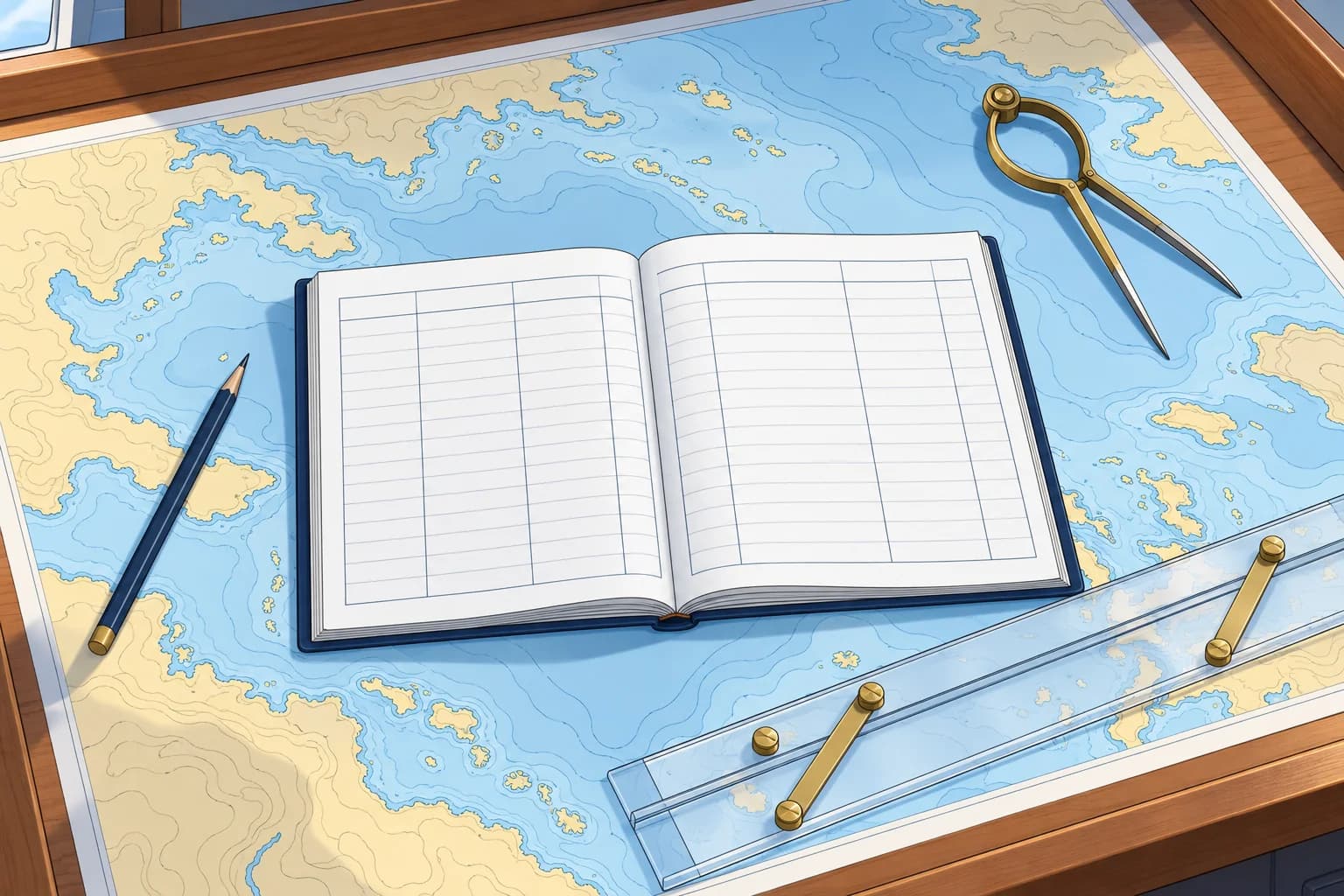
Why a record
SOLAS chapter V, regulation 19, requires every ship to have a means of correcting headings and bearings to true at all times. On a ship, that means knowing the current gyro and magnetic compass errors. Flag states and company procedures usually require a compass error book, or record of compass errors, kept on the bridge. Most flags also require a deviation card for the magnetic compass.
What to write
For each check, record the date, time and position, the ship's head by gyro and by magnetic compass, and the method used. Add the object or body observed, its true bearing, its gyro bearing and the gyro error. Then add the magnetic compass error, the variation and the resulting deviation. Sign it. A check that is not written down cannot help the next watch.
Reading the trend
A healthy gyro shows a small error that stays steady from watch to watch, typically a fraction of a degree. A sudden jump, an error that keeps growing, or an unexpected gyro–magnetic change after allowing for variation and deviation calls for an independent check. If you suspect a heading-equipment failure, notify the master immediately and use a verified independent heading source. Check corrector inputs, alarms and repeaters, and log the findings.
Applying the error
Apply the latest checked error to headings and bearings. With gyro error 1.0° E, a gyro heading of 090° means a true heading of 091° T. Wind and current may make your track different. A bearing of 270° by gyro is 271° T. After a corrector change or restart, check the error again before applying it.
Magnetic deviation
Compare the gyro, corrected for its checked error, with the standard compass on several headings. Allow for current variation to check the deviation card. Deviation can change with heading, cargo, structural work or equipment near the compass. Confirm an unexpected difference by another observation and check for interference. Investigate persistent differences; excessive or erratic deviation may require adjustment under flag-state and company requirements.
Remember
- SOLAS V/19 requires a means of correcting headings and bearings to true at all times.
- Log every check: time, position, method, true and observed bearings, gyro error, deviation and signature.
- A steady small error is normal. A sudden or growing change means investigate and report.
- Apply only a current, checked error. Check again after any restart or corrector change.
Common mistakes
Wrong: If the gyro error is small, there is no need to write it down.
Right: Log every check. The record shows the trend that reveals a developing fault, and the next watch relies on it.
Wrong: An error found last week can still be applied today.
Right: Apply the latest checked error. After a restart, a corrector change or a big manoeuvre, check again before relying on it.
Worked case
The error book shows the gyro error steady at 0.5° E for a week. This morning's amplitude gives 2.5° W, while the gyro–magnetic difference on the same heading has also changed by about 3°. What do you do?
Show the answer
Notify the master immediately and use a verified independent heading source. Repeat the check independently. Check corrector inputs, alarms and repeaters, and log the findings. A repeat observation confirms the error only at that moment; it does not prove the gyro is stable. Continue using the verified independent heading source under the master’s orders until gyro reliability is established.
Practice question
Which SOLAS chapter V requirement does the compass error book support?
- Carrying a voyage data recorder on passenger ships
- Correcting headings and bearings to true at all times
- Keeping a deck log of all radio communications
- Testing the steering gear twelve hours before sailing
Show the answer
Answer: B. Regulation 19 requires a means of correcting heading and bearings to true at all times. A current error record makes that possible.